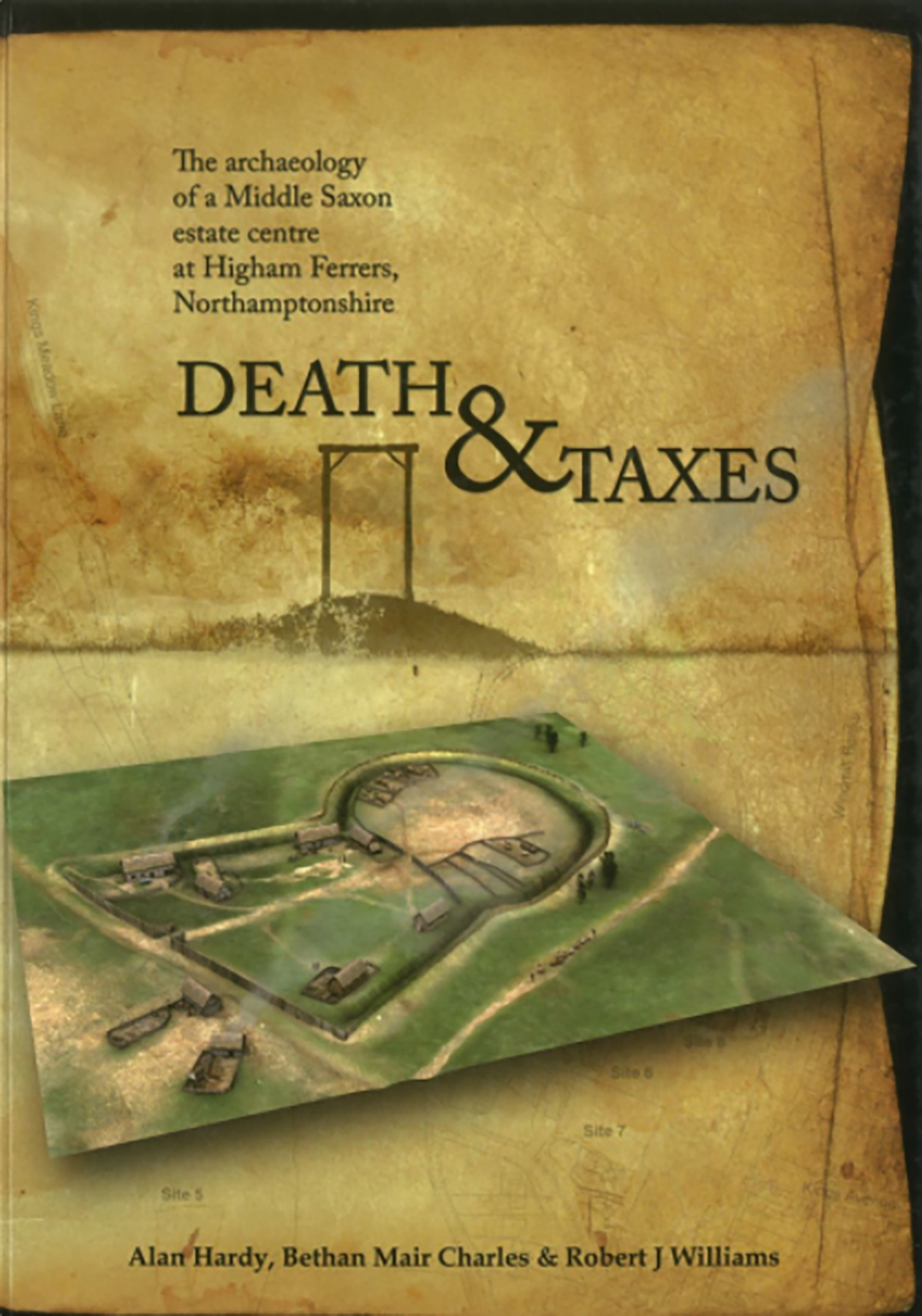
Oxford Archaeology Monograph 4
Death and Taxes: The Archaeology of a Middle Saxon Estate Centre at Higham Ferrers, Northamptonshire
By Alan Hardy, Bethan Mair Charles, Robert J. Williams

Hardback
£19.99
Add to basket
 Add to wishlist
Excavations north of Higham Ferrers revealed early Saxon SFBs, followed by an 8th‑century royal tribute centre with enclosures, buildings, a malting oven and execution burials, destroyed around 800. Later activity included 9th‑century farmsteads and a significant medieval pottery industry.
READ MORE
Between 1993 and 2003, Oxford Archaeology (formerly Oxford Archaeological Unit) undertook a major programme of survey and excavation on the northern outskirts of the town of Higham Ferrers, Northamptonshire, uncovering extensive remains dating from the Middle Bronze Age to the late medieval period. This volume deals with the Anglo-Saxon and medieval remains. Post-Roman occupation began as early as the mid to late 5th century, with scatter of Sunken Featured Buildings and a few associated pits. No obvious evidence was found to indicate any continuity between the late Roman and early Saxon occupation. A possible brief interval in the 7th century was followed by the establishment of a large 8th-century complex of enclosures and buildings, along with other structures including a large malting oven. It is argued that this represents the infrastructure of a purpose-built tribute centre for a royal estate, a type of site not hitherto recognised in England. While the quantity of material evidence of this period is modest, the character of it indicates that a wide variety of produce came into complex and was then redistributed rather than consumed on site. Evidence of other functions of the complex were revealed in the form of human remains – interpreted as execution victims, found in parts of the enclosure ditches. At around the end of the 8th century the evidence suggests that the complex was abruptly and completely destroyed and the landscape cleared. The chronology as determined by the material evidence was augmented by a programme of radiocarbon and archaeomagnetic dating. Starting in the 9th century, occupation resumed in the area, in the form of a scatter of farmsteads. Evidence was also found of a substantial pottery industry producing Late medieval Reduced Ware.