Thames Valley Landscapes Monograph 38
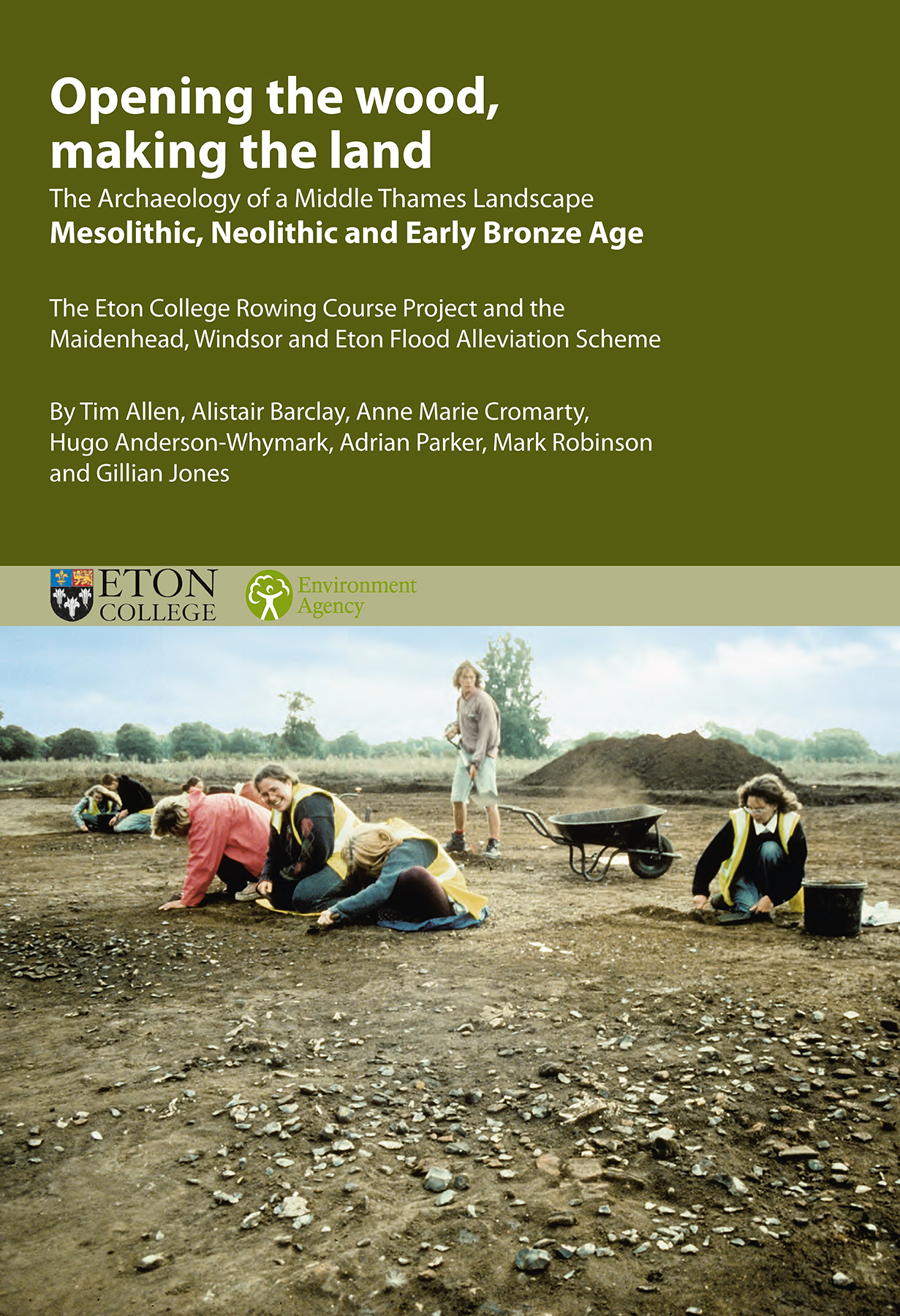
Opening the Wood, Making the Land: The Archaeology of a Middle Thames Landscape
The Eton College Rowing Course Project and the Maidenhead, Windsor and Eton Flood Alleviation Scheme
By Tim Allen, Alistair Barclay, Anne Marie Cromarty, Hugo Anderson-Whymark, Adrian Parker

Paperback
£35.00
Add to basket
 Add to wishlist
Excavations at the Eton Rowing Course and the Maidenhead–Windsor Flood Alleviation Channel revealed Mesolithic flint scatters, rich early Neolithic middens in former channels, middle–late Neolithic burials, and Beaker/early Bronze Age ring ditches and settlement evidence across a complex Thames palaeochannel landscape.
READ MORE
Excavations at the Eton Rowing Course and along the Maidenhead to Windsor Flood Alleviation Channel revealed extensive evidence for occupation in all of the conventional periods of prehistory from the Mesolithic to the early Bronze Age. The two projects revealed a complex sequence of palaeochannels of the Thames which ran between a number of gravel islands. Features and artefact scatters revealed were distributed across these gravel islands and the floodplain adjacent to the channels, in some cases being preserved in sequences of alluvium. Extensive early Neolithic midden deposits had been preserved in hollows which had formed by the partial infilling of earlier palaeochannels. A number of finds, including human remains, were recovered from deposits within the channels themselves. The earliest significant evidence for occupation was provided by an extensive concentration of early Mesolithic flint, situated along the edge of a former channel of the Thames which ran through the area of the Rowing Course. A number of smaller scatters of similar date were found in similar contexts elsewhere on the Rowing Course. Late Mesolithic worked flint was recovered from tree-throw holes and as scatters on the floodplain and on one of the Gravel Islands. Perhaps the most significant discoveries were three early Neolithic midden deposits, preserved in hollows formed by the infilling of earlier palaeochannels, at Sites 6 and 10 on the Eton Rowing Course and at Lake End Road West on the Flood Alleviation Channel. Similar deposits found at Amerden Lane had clearly suffered from much more significant disturbance than those at the other sites. The midden deposits on Sites 6 and 10, in particular, contained large quantities of pottery (largely Carinated, Plain and Decorated Bowl, but including also later styles), worked flint, animal bone and other finds. Similar ranges of finds were also recovered on these sites from tree-throw holes and pits. Modelling of radiocarbon dates suggests that the midden deposits in Area 6 had built up over a considerable period of time. Further evidence for activity in the early Neolithic was provided by flint scatters on a gravel island on the Rowing Course, finds from pits and tree-throw holes at other sites, including one at Marsh Lane West which contained a small quantity of cremated human remains, and a human skull recovered from a palaeochannel. It is possible that an oval barrow at Marsh Lane East Site 2 was originally constructed in the early Neolithic, although it was recut in the late Neolithic/early Bronze Age. In contrast to the early Neolithic, middle Neolithic activity was evidenced most extensively by finds from pits which usually occurred in pairs or small groups. More exceptional evidence for activity in the middle Neolithic was provided by two inhumation burials and two cattle burials from Areas 6 and 10, as well as a human skull from a former channel of the Thames. Evidence for activity in the late Neolithic was more limited, but at the Rowing Course a small number of isolated pits and tree-throw holes dating from this period were identified. More exceptional finds, including part of a human skeleton were again recovered from the former channel of the Thames. Evidence for activity in the Beaker period and the early Bronze Age included ring ditches in Areas 6and 16 on the Rowing Course and at Marsh Lane East Site 2. One of the ring ditches at the latter site was associated with a central cremation burial in a Collared Urn, in a pit which also contained deposits of pyre material and possibly the remains of a bier. Alongside these monuments, evidence of settlement was also found, consisting of scatters of worked flint, spreads of burnt flint, a hearth, and pits and tree-throw holes on the floodplain and gravel islands.