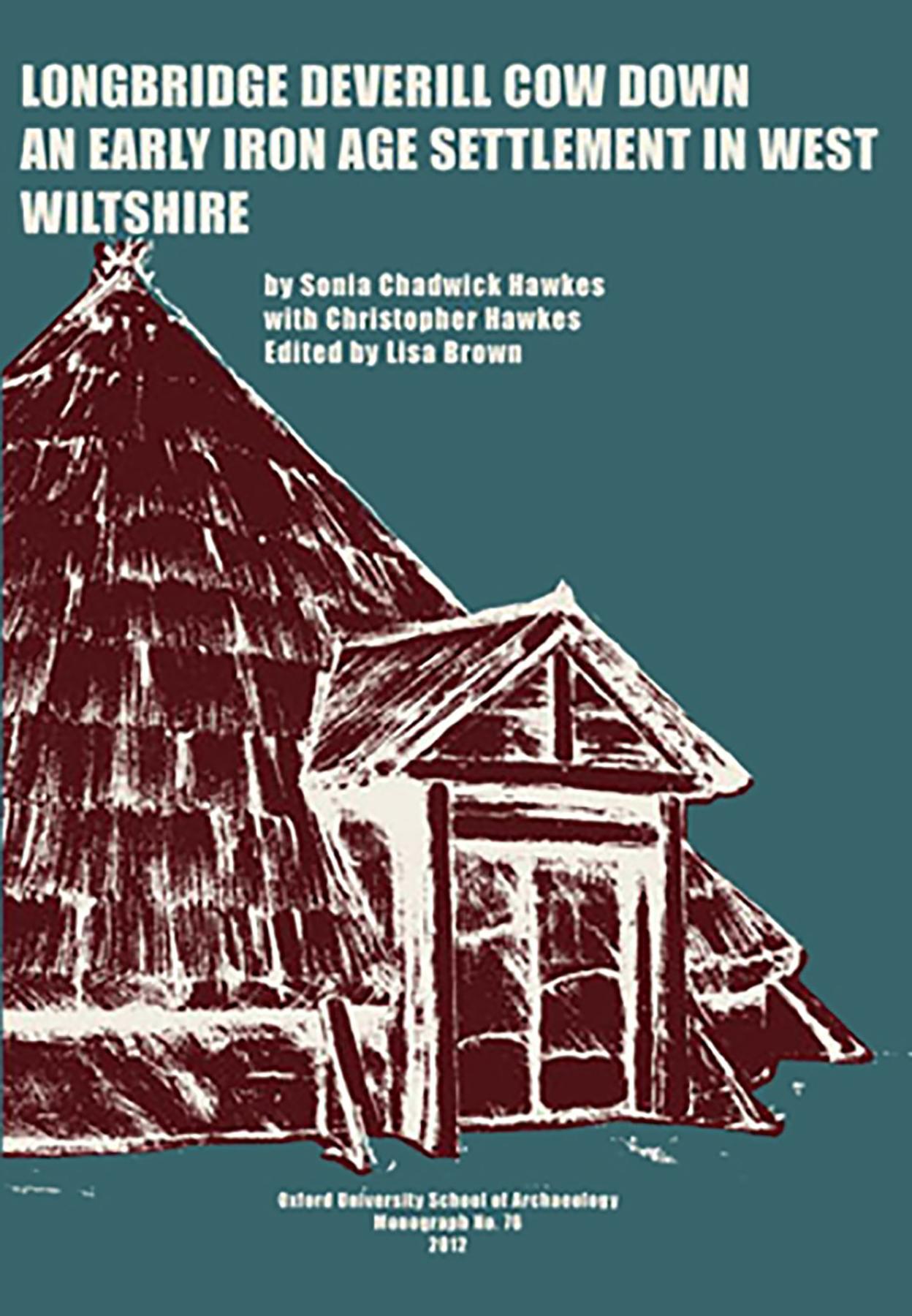
Oxford University School of Archaeology Monograph 76
Longbridge Deverill Cow Down
An Early Iron Age Settlement in West Wiltshire
Edited by Lisa Brown

Paperback
£25.00
Add to basket
 Add to wishlist
This volume publishes Sonia Chadwick Hawkes’ excavations of the early Iron Age settlement at Longbridge Deverill Cow Down, a key British Iron Age site. Featuring well-preserved roundhouses and a remarkable pottery assemblage linked to their destruction, it provides fresh insights into settlement, ritual and landscape use on Salisbury Plain.
READ MORE
The early Iron Age settlement at Longbridge Deverill Cow Down, Wiltshire was excavated between 1956 and 1960 by the late Sonia Chadwick Hawkes. Funding was provided by the then Ministry of Works to investigate a well-defined D shaped enclosure on the Down in advance of tree plantation. The enclosure was known from vertical photographs taken by the RAF for the national air survey shortly after WWII, but aerial survey carried out by J.K. St. Joseph at the start of the excavation, after the Down had been ploughed, revealed that it was one of a complex of three enclosures. The results of the survey and of the initial excavation prompted a continuation of the fieldwork in order to establish the stratigraphic and chronological sequence of the settlement.
A field survey of the site and surrounding area undertaken during the excavation by Collin Bowen of RCHM was continued over several years by David McOmish of English Heritage, and the results were drawn together for this volume. The excavation programme involved digging trenches across the earthworks of the three enclosures and an investigation of their interiors. The D-shaped enclosure proved to be a later enhancement or addition to a major early Iron Age enclosure, which probably served as a stock pen well into the medieval period. The well preserved remains of four roundhouses that lay within two of the enclosures represent a settlement occupied between the 9th and 6th centuries BC. At least two of these structures were burnt out, possibly deliberately, preserving abundant pottery and other artefacts. Some 70 excavated pits that postdated the roundhouse settlement, probably by about 200 years or more, must have been associated with a later settlement that lay largely beyond the excavated areas. Unusually for the time, basic environmental sampling was carried out and organic material was submitted for radiocarbon dating.
Sonia and Christopher Hawkes spent many years following the excavation bringing together elements of the stratigraphic and specialist reports with the assistance of students and specialists. The site archive was ordered during the 1990s but at the time of Hawkes’ death in 1999 this important site remained largely unpublished. The publication of this volume has been supported by the Hawkes Estate, overseen by Professor Helena Hamerow of the School of Archaeology at the University of Oxford, and funded by English Heritage, within the scope of their Implementation Plan for Exploring our Past 1998.