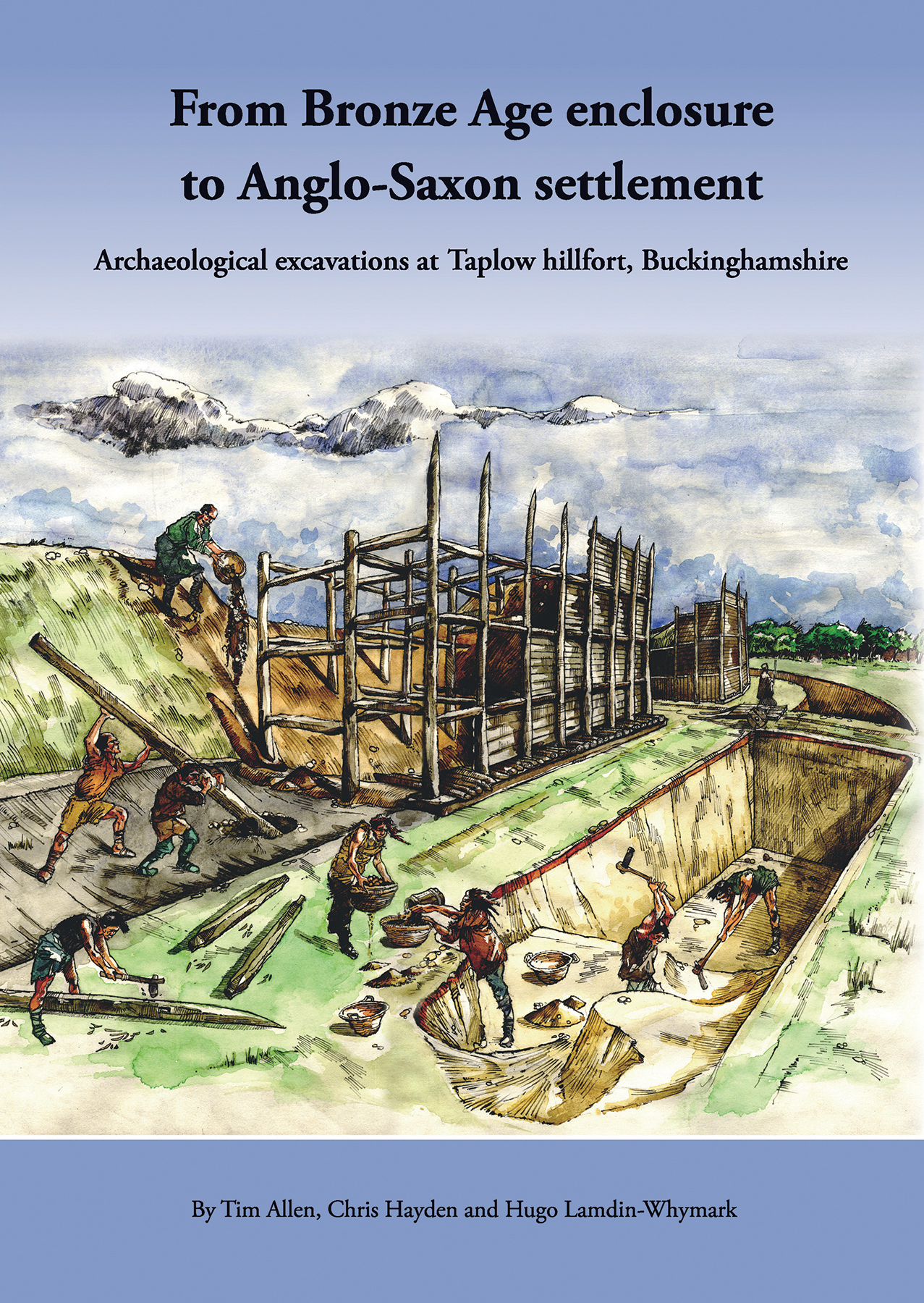
Thames Valley Landscapes Monograph 30
From Bronze Age Enclosure to Saxon Settlement: Archaeological Excavations at Taplow Hillfort, Buckinghamshire, 1999-2005
By Tim Allen, Chris Hayden, Hugo Lamdin-Whymark

Hardback
£20.00
Add to basket
 Add to wishlist
This book reveals the long urban history of Finzel’s Reach, from Saxon defences and medieval Templar‑ and Hospitaller‑led development to later sugar refining and brewery use. Excavation, building survey and geoarchaeology uncover a dynamic landscape of reclamation, streets, tenements and industry at Bristol’s historic core.
READ MORE
Recent excavations at Taplow Court (at NGR SU 907 823), undertaken in advance of the construction of a Conference Hall for the owners Soka Gakkai International-UK, have revealed a long sequence of activity stretching from the Mesolithic to the Anglo-Saxon period. Mesolithic struck flints and charred hazelnuts, and early Neolithic flints, were found in a small number of tree-throw holes. A group of intercutting hollows or shallow pits of early Bronze Age date included sherds of Collared Urn and worked flint, rare evidence of domestic activity of this period. There were also finds of the middle Bronze Age, although no features of that phase were confirmed. In the late Bronze Age, a defensible hilltop enclosure, just over 1 ha in area, was constructed on the site. The enclosure, probably first established in the 11th century BC, had a complex sequence of defences including a pair of posthole rows possibly indicating a timber palisade backed by a raised walkway, a trench-built palisade, a ditch and rampart and further posthole-lines outside the ditch. Only a limited area of the interior was examined, but it contained a series of parallel fence lines, one probable roundhouse and up to six possible four-post structures, with occupation extending into the 9th century BC. There followed a probable hiatus in activity represented by a very slow-forming deposit – termed in this report the ‘standstill’ layer – in the upper part of the ditch. Subsequently a larger U-profiled hillfort ditch was constructed in the early Iron Age, probably in the 5th century BC, the spoil being dumped over the previous ditch to form a timber-laced rampart. Another internal roundhouse may be middle Iron Age in date. Soon after its construction the rampart was destroyed in places by fire, and remains of the charred timbers within the rampart have revealed some details of the ramparts construction. In contrast, the associated ditch remained open into the Saxon period. A third and even larger V-profiled ditch was found outside the second ditch. Although the date of construction of this outer ditch is uncertain, it too remained open into the Saxon period, suggesting that the hillfort was multivallate in its later stages. The abandoned hillfort was re-occupied in the Saxon period, probably in the late 6th or early 7th century AD, at roughly the same time as the rich burial within the Taplow Mound. No evidence for reconstruction of the hillfort was found but considerable quantities of domestic material were deposited within the surviving Iron Age hillfort ditches. Amongst the domestic debris was a sherd probably from an eastern Mediterranean amphora, the first from Buckinghamshire, and an indicator of high status. A fragmentary early Anglo-Saxon inhumation associated with a knife was found in the entrance to the hillfort. The ditches were finally infilled in the 11th-12th century AD.