
Publishing Scholarly Archaeology since 1997
Publishing Scholarly Archaeology since 1997
Log in | My Account | Basket Twitter Facebook LinkedIn
Advanced Search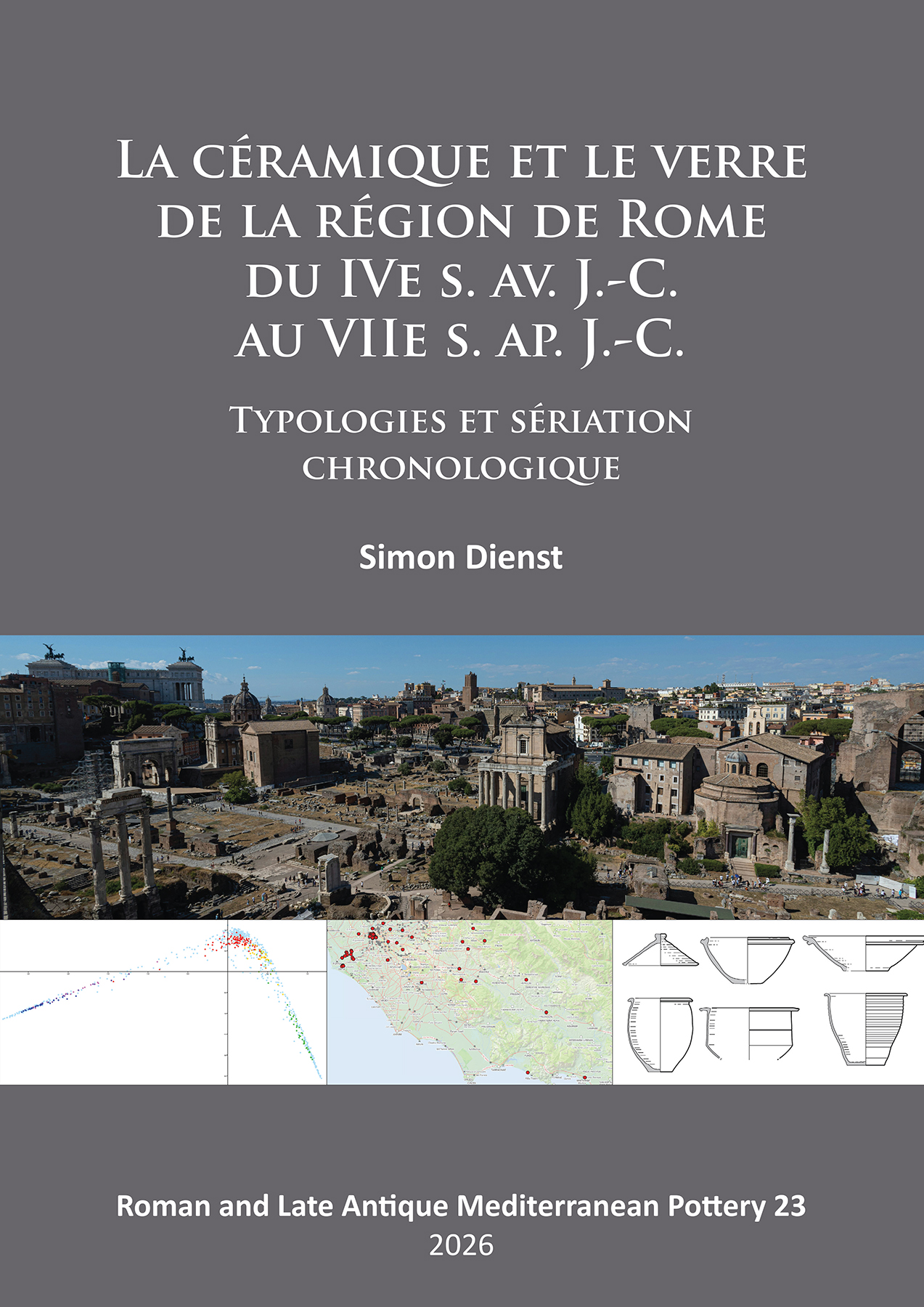
H 297 x W 210 mm
392 pages
38 figures, 85 tables, 94 plates (colour throughout)
French text
Published Dec 2026
ISBN
Paperback: 9781805834045
Digital: 9781805834052
Keywords
Roman pottery; Late Antique pottery; Roman glass; Late Antique glass; Latium; Common ware; Coarse ware; Ceramic typologies; Ceramic seriation; Ceramic horizons; Material culture
Related titles


Roman and Late Antique Mediterranean Pottery 23
La céramique et le verre de la région de Rome du IVe s. av. J.-C. au VIIe s. ap. J.-C.
Typologies et sériation chronologique
By Simon Dienst

Paperback
£55.00
 Add to wishlist
Drawing on 425 archaeological contexts from the region of Rome and southern Latium, this study establishes a new chronological framework for pottery and glass from the fourth century BC to the seventh century AD. Combining typological analysis with statistical seriation, it provides a major reference resource for Roman ceramic studies.
Contents
Préface – Xavier Deru
Remerciements
Introduction
État de l’art
Apports et limites de l’étude
Structure de l’ouvrage
Les sites de référence
Catégories et typologies
Critères de classification
Bucchero (BUC)
Céramique à figures rouges (CFR)
Céramique à vernis noir (CVN) et/ou à vernis rouge (CVN/R et CVR)
Terres sigillées (TS)
Céramique à revêtement argileux (R-ARG)
Céramique à glaçure plombifère (PB)
Céramique décorée (DEC)
Céramique à parois fines (PF) et engobée (EN)
Céramique dite « italo-mégarienne » (IT-MG)
Céramique commune claire (CC, CC2, CC-P, CC-AF, CC-OR)
Céramique de cuisson (RUA, RUA1, RUA-AF, RUA-OR) et brûle-parfums
Céramique à vernis rouge interne (VRP)
Céramique non tournée (CNT)
Amphores (AM)
Dolia (DO)
Unguentaria (UNG)
Ollae perforatae (OP)
Verre
Sériation des assemblages et constitution des horizons
Méthodologie
Constitution des horizons régionaux
Présentation des horizons régionaux
Horizon régional 1
Horizon régional 2
Horizon régional 3
Horizon régional 4
Horizon régional 5
Horizon régional 6
Horizon régional 7
Horizon régional 8
Horizon régional 9
Horizon régional 10
Horizon régional 11
Horizon régional 12
Horizon régional 13
Horizon régional 14
Conclusion et perspectives
Bibliographie
Planches
About the Author
Simon Dienst holds a PhD in History, Art History and Archaeology from the University of Liège. He wrote his doctoral thesis on the tableware from the Piano della Civita in Artena, in Lazio. His research focuses on ancient and late-antique ceramics and glass, primarily in central Italy. He combines a traditional approach to artefacts with archaeometric and statistical analyses, adopting a holistic approach.
Having previously worked at Pompeii and helped develop ONICer, he is currently a research associate at the Department of Art History and Greco-Roman Archaeology at the University of Liège. He is also a member of international research teams in Italy (Ostia Antica, Artena) and Spain (Baelo Claudia). He is responsible for the development of the DBCer and LOGACer software programmes and the CeVICA database. He is the author of several articles published in international journals, conference proceedings and specialist monographs.
En français
Simon Dienst est Docteur en Histoire, histoire de l’art et archéologie auprès de l’Université de Liège. Il a réalisé sa thèse de doctorat sur la vaisselle du Piano della Civita à Artena, dans le Latium. Ses recherches portent sur la céramique et le verre antique et tardo-antique, principalement en Italie centrale. Il combine une approche traditionnelle du mobilier avec des analyses archéométriques et statistiques, dans une approche globalisante.
Ayant auparavant travaillé à Pompéi et aidé au développement d’ONICer, il est actuellement collaborateur scientifique auprès du Service d’Histoire de l’Art et Archéologie gréco-romaine de l’Université de Liège. Il est également membre de missions internationales en Italie (Ostia Antica, Artena) et en Espagne (Baelo Claudia). Il est responsable du développement des logiciels DBCer, LOGACer et de la base de données CeVICA. Il est auteur de plusieurs articles publiés dans des revues internationales, des actes de colloque et des ouvrages spécialisés.

Archaeopress Publishing Ltd
First and Second Floor
13-14 Market Square
Bicester
Oxfordshire OX26 6AD
United Kingdom
Tel +44 (0) 1865 311914 | fax +44 (0) 1865 512231 | email info@archaeopress.com
