
Publishing Scholarly Archaeology since 1997
Publishing Scholarly Archaeology since 1997
Log in | My Account | Basket Twitter Facebook LinkedIn
Advanced Search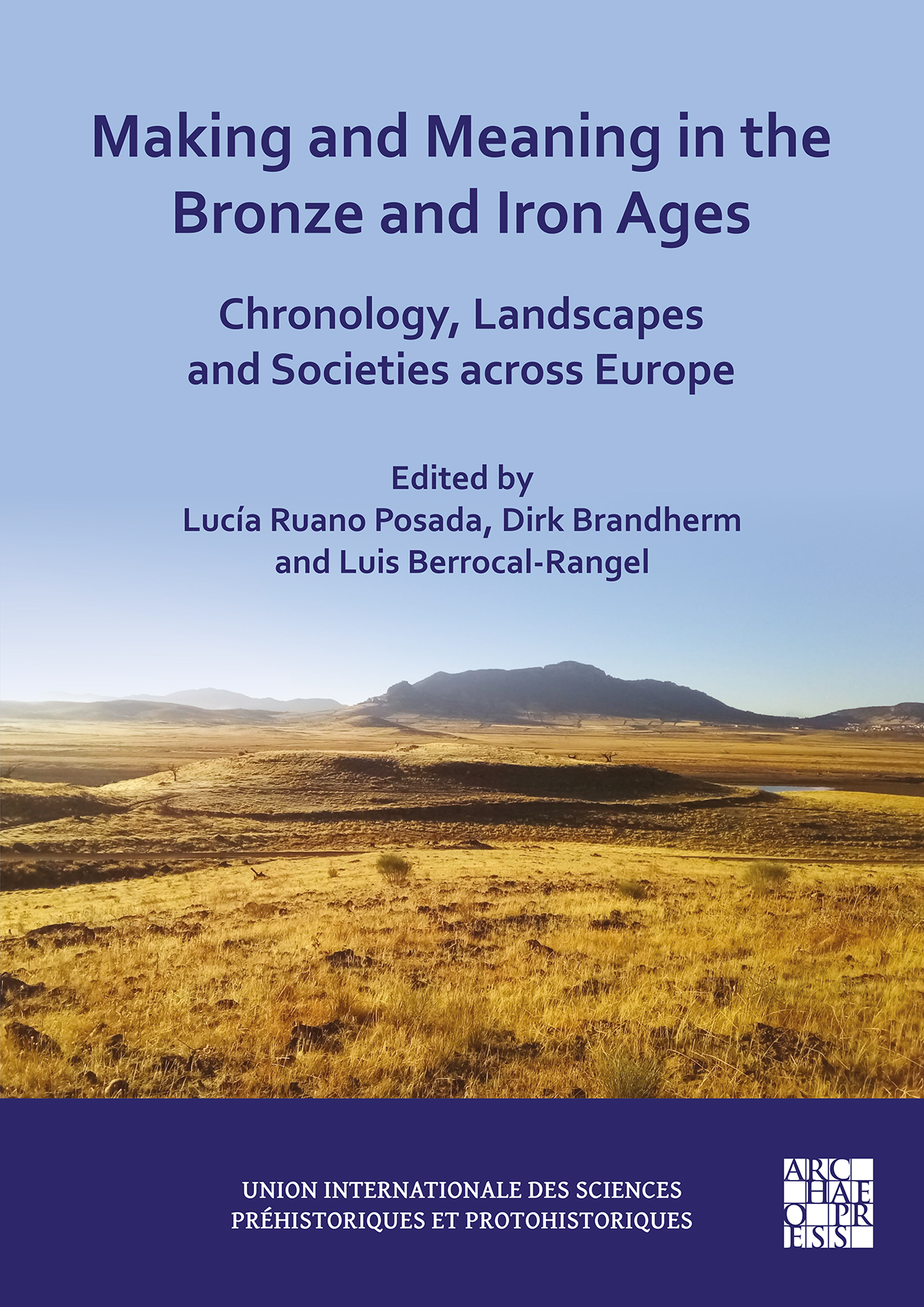
Download Sample PDF
H 290 x W 205 mm
202 pages
104 figures (colour throughout)
Published Aug 2026
ISBN
Paperback: 9781805833567
Digital: 9781805833574
Keywords
European Prehistory; Metal Ages; Chronology; Scientific Dating; Craft; Domesticity; Networks
Related titles


Union Internationale des Sciences Préhistoriques et Protohistoriques
Making and Meaning in the Bronze and Iron Ages
Chronology, Landscapes and Societies across Europe. Proceedings from the METALAGES2024 Colloquium (Florence, 23 October 2024)
Edited by Lucía Ruano Posada, Dirk Brandherm, Luis Berrocal-Rangel

 Add to wishlist
Selected papers from METALAGES2024 explore chronology, material culture and society in Bronze and Iron Age Europe and the Mediterranean. Combining scientific dating methods with studies of settlement, craft, identity and exchange, it highlights how chronology and archaeological interpretation together illuminate prehistoric social change.
Contents
Editors’ Foreword – Lucía Ruano Posada, Dirk Brandherm and Luis Berrocal-Rangel
Thematic Session: Chronological Methods and their Correlation in the Metal Ages
La cronologia dell’antica età del Bronzo tra Lombardia orientale e Veneto occidentale: dalle datazioni assolute dendrocronologiche e radiocarboniche alla tipocronologia dei materiali – Marco Baioni, Federica Gonzato, Cristina Longhi, Claudia Mangani and Nicoletta Martinelli
Bronze Age dates from the archaeological site of Sa Osa – Cabras – Anna Depalmas, Carmine Lubritto, Rita T. Melis, Mark Pearce and Alessandro Usai
The Early Bronze Age settlement of Asparn-Schletz/Lower Austria. A site in the light of quantitative methods – Elisabeth Rammer
Dynamics of Bronze Age upland settlement in Ireland and Northern Britain in a comparative perspective: Irish results to date – Cherie Edwards
General Session: Current Research in the Metal Ages
On ne naît pas femme : on meurt comme telle. Sex, gender and personhood in the Early Bronze Age – Sabrina N. Autenrieth
New research on prehistoric fortifications in Austria – Results of the Dietenberg excavations in Styria – Florian Mauthner and Klaus Schindl
Underwater hillforts: Assessing the opportunities and challenges of flood-prone archaeological sites – Pablo Paniego Díaz, Lucía Ruano Posada, Iratxe Boneta Jiménez and Timoteo Rivera Jiménez
Tanners and leatherworkers in ancient Iberian society (6th–2nd centuries BC). A social approach to production – Pablo S. Harding-Vera
Exploring domestic economies through network analysis: The case of El Castrejón de Capote – Lucía Ruano Posada, Luis Berrocal-Rangel, Pablo Paniego Díaz, Pablo Sánchez de Oro and Nerea Dacosta Menéndez
The ancient horizon in the Iberian world of the region of Murcia. The formation and emergence of a new culture through the reception of Greek pottery – José Fenoll Cascales, Jesús Robles Moreno and José Miguel García Cano
Le dinamiche preistoriche dell’entroterra della Sicilia occidentale legate al Mediterraneo – Angelo Vintaloro
About the Author
Lucía Ruano Posada is a postdoctoral researcher at the University of Lisbon (UNIARQ), specialising in Iron Age and later prehistoric archaeology of the Iberian Peninsula. Her research focuses particularly on domestic architecture, household organisation, earthen building technologies, and the socio-technical dynamics of settlement spaces, drawing on geoarchaeology, ethnoarchaeology, archaeometry, and spatial analysis. She has contributed actively to international scholarly networks and UISPP activities, including the organisation of conference sessions and edited publications.
Dirk Brandherm is Reader in Prehistoric Archaeology at Queen’s University Belfast, specialising in the Chalcolithic, Bronze and Iron Ages of Atlantic Europe and the Mediterranean. His research addresses later prehistoric social change, chronology and scientific dating, metallurgy, and the archaeometric study of material culture, with a particular interest in exchange and connectivity. He has led and contributed to numerous international collaborative projects and currently serves as President of the UISPP Metal Ages Commission.
Luis Berrocal-Rangel is Professor of Prehistory at the Autonomous University of Madrid, where he also serves as Head of the Department of Prehistory and Archaeology. A leading specialist in Iberian Iron Age and Hispano-Celtic archaeology, his research encompasses settlement archaeology, protohistoric architecture, fortified landscapes, identity, and cultural interaction across Iberia. He combines extensive fieldwork with broader theoretical perspectives on social complexity and has long been involved in international research collaborations and UISPP initiatives.

Archaeopress Publishing Ltd
First and Second Floor
13-14 Market Square
Bicester
Oxfordshire OX26 6AD
United Kingdom
Tel +44 (0) 1865 311914 | fax +44 (0) 1865 512231 | email info@archaeopress.com
