
Publishing Scholarly Archaeology since 1997
Publishing Scholarly Archaeology since 1997
Log in | My Account | Basket Twitter Facebook LinkedIn
Advanced Search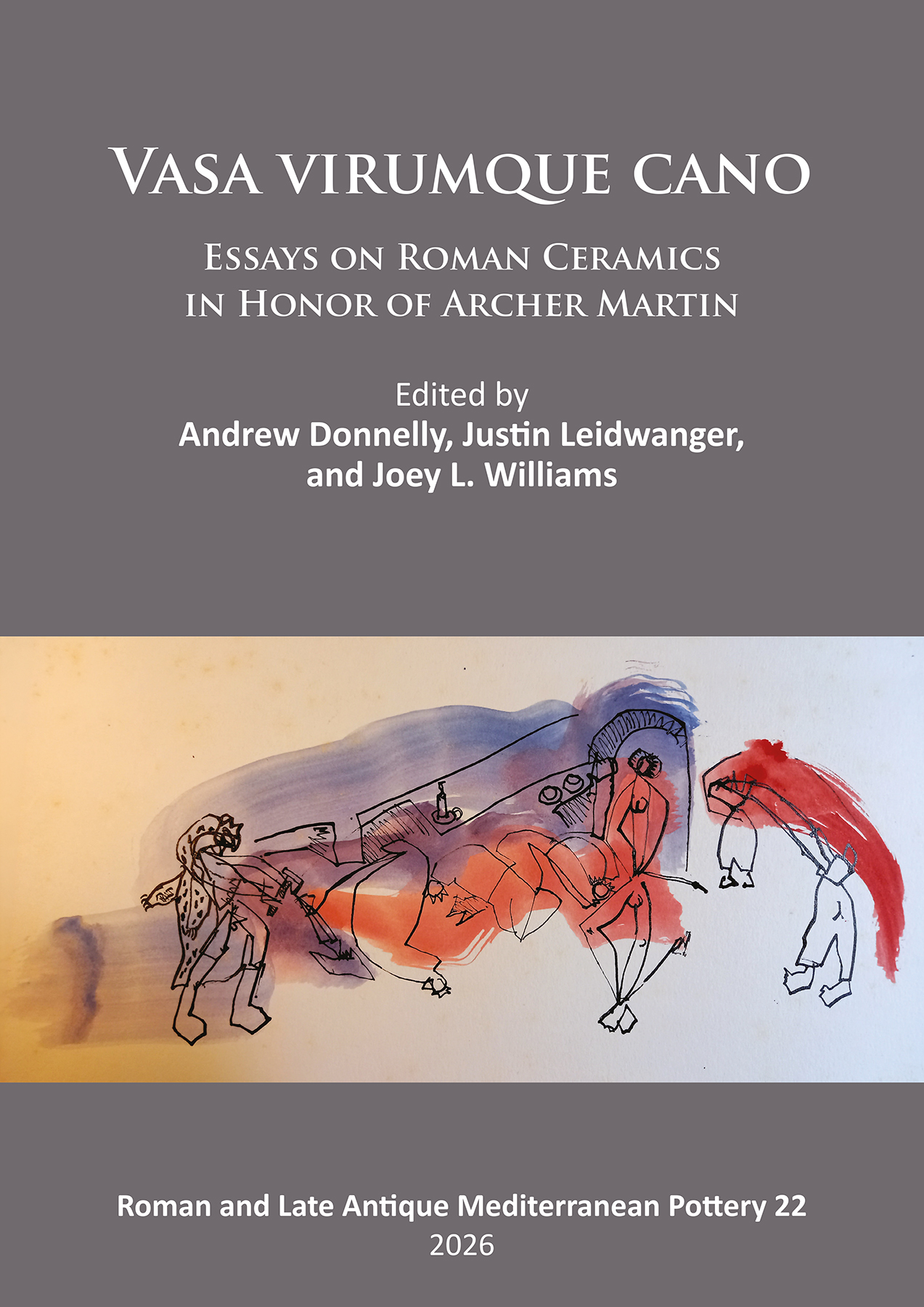
Download Sample PDF
H 297 x W 210 mm
370 pages
204 figures, 12 tables (colour throughout)
Published Dec 2026
ISBN
Paperback: 9781805833482
Digital: 9781805833499
Keywords
Ancient Rome; Ceramics; Networks; Production; Exchange; Pedagogy; Ancient economy; Transport amphoras
Related titles


Roman and Late Antique Mediterranean Pottery 22
Vasa Virumque Cano: Essays on Roman Ceramics in Honor of Archer Martin
By Andrew Donnelly, Justin Leidwanger, Joey L. Williams

Paperback
£55.00
 Add to wishlist
Vasa virumque cano honours ceramicist and archaeologist Archer Martin through 25 chapters by students and collaborators. Exploring Mediterranean pottery, archaeological method and interdisciplinary research, the volume highlights Martin’s influence on ceramic studies, teaching and new approaches to understanding past societies.
Contents
List of Figures and Tables
Tabula gratulatoria
Assembling Sherds, Assembling Stories – Andrew Donnelly, Justin Leidwanger, and Joey L. Williams
Section One: Italy
Contextualizing the Construction of Ostia’s Third-Century Castrum – Mary Jane Cuyler
The Scoppieto Archaeological Excavation in the Parco Fluviale del Tevere (Tiber River Park): A Means for Knowledge and Enhancement of a Territory – Margherita Bergamini Simoni
Plantas y perfumes. A propósito de las ollae perforatae/macetas en las perfumerías de Pompeya. – Albert Ribera i Lacomba, Jean-Pierre Brun, and Macarena Bustamante-Álvarez
Productions and Producers of Terra sigillata at Cosa (Ansedonia, GR) between Past and Recent Research – Ilaria Romeo and Martina Rodinò
The Gods of Monte Pallano – Amalia Faustoferri and Susan Kane
Recreating an Umbrian Augustan Villa on the Tiber – David Soren, Luca Mandolesi, Barbara Maurina, Roberto Montagnetti, and David Pickel
Insediamenti e commercio presso il fiume Tevere nell’Umbria meridionale romana – Matteo Serpetti
Section Two: The Roman World
Supply Patterns in Dacia Porolissensis: Pottery Evidence from the Porolissum Forum Project – Eric C. De Sena
Von Keramik zu Glas und vice versa im kaiserzeitlichen und frühbyzantinischen Olympia – Christa Schauer
Illuminating the Underground: Technical, Social, and Economic Aspects of Terracotta Oil Lamps in Roman Mines – Linda R. Gosner
Commercial Evolution between AD 190 and 525 at Almoínhas (Province of Lusitania) – José Carlos Quaresma and Martim Lopes
Ceramics from the Southwest Garbage Dump in the Roman Villa at Tourega (Évora, Portugal) – Catarina Viegas and Inês Vaz Pinto
Section Three: Ceramics on the Move
An Enigmatic Oil Lamp from Kranj – Verena Perko
Expanding the Footnotes to LRP AfRS form 124 and Going off on a Tangent – Kathleen Warner Slane
Fragmented Stories of Pottery at the Moesian Frontier: Long-Distance Trade in Late Roman Times – Tatjana Cvjetićanin
Egyptian Coarse Wares and Amphorae from the Palatine Hill, Rome – Victor M. Martínez
Pottery as Evidence of Traders in Germania Inferior – Roderick C.A. Geerts
Multivalent Containers on the Move: Unguentaria from the Marzamemi 2 Shipwreck – Justin Leidwanger and Andrew Donnelly
Section Four: New Directions
Recognizing and Documenting Ancient Repairs on Roman Pottery – Laura M. Banducci
L’evoluzione delle ricerche archeologico-archeometriche sulle anfore africane d’epoca romana e il loro contributo alla ricostruzione della storia socio-economica del Mediterraneo occidentale – Michel Bonifay and Claudio Capelli
Spindle-Shaped Amphorae from Kom Wasit and Kom al-Ahmer (Western Nile Delta-Egypt) – Cristina Mondin and Mohamed Kenawi
Roman Ceramic Assemblages: Looking for High and Low Presences and Noisy Absences – Simonetta Menchelli
An Etruscan View of the François Vase – Ingrid D. Rowland
Section Five: Conclusions
Pottery and Pedagogy: Teaching Archaeological Ceramics Using the ‘Archer Martin Method’ – Joey L. Williams and Sarah Trabert
Heinrich Schliemann agli scavi di Ostia Antica: suggestioni virgiliane? – Elizabeth J. Shepherd
About the Author
Andrew Donnelly, Assistant Professor of History at Texas Tech University, has conducted fieldwork in Italy and far beyond. His research focuses on foodways, specifically the relationship between ceramic objects and textual sources and the information that can be gained from studying them in conjunction.
Justin Leidwanger, Associate Professor of Classics at Stanford University, conducts fieldwork primarily in Türkiye and Italy, most recently on the late antique “church wreck” at Marzamemi. His research emphasizes the logistics and technologies of distribution, including the standardization of transport amphoras.
Joey L. Williams, Senior Lecturer of Classics and Letters at the University of Oklahoma and Associate Director of its Center for Mediterranean Archaeology and History, has directed fieldwork in Portugal and Italy. He researches the impact of surveillance on landscapes and people, with a focus on the role ceramic objects play in cultural exchange across contested borderlands.
Archaeopress Publishing Ltd
First and Second Floor
13-14 Market Square
Bicester
Oxfordshire OX26 6AD
United Kingdom
Tel +44 (0) 1865 311914 | fax +44 (0) 1865 512231 | email info@archaeopress.com
