
Publishing Scholarly Archaeology since 1997
Publishing Scholarly Archaeology since 1997
Log in | My Account | Basket Twitter Facebook LinkedIn
Advanced Search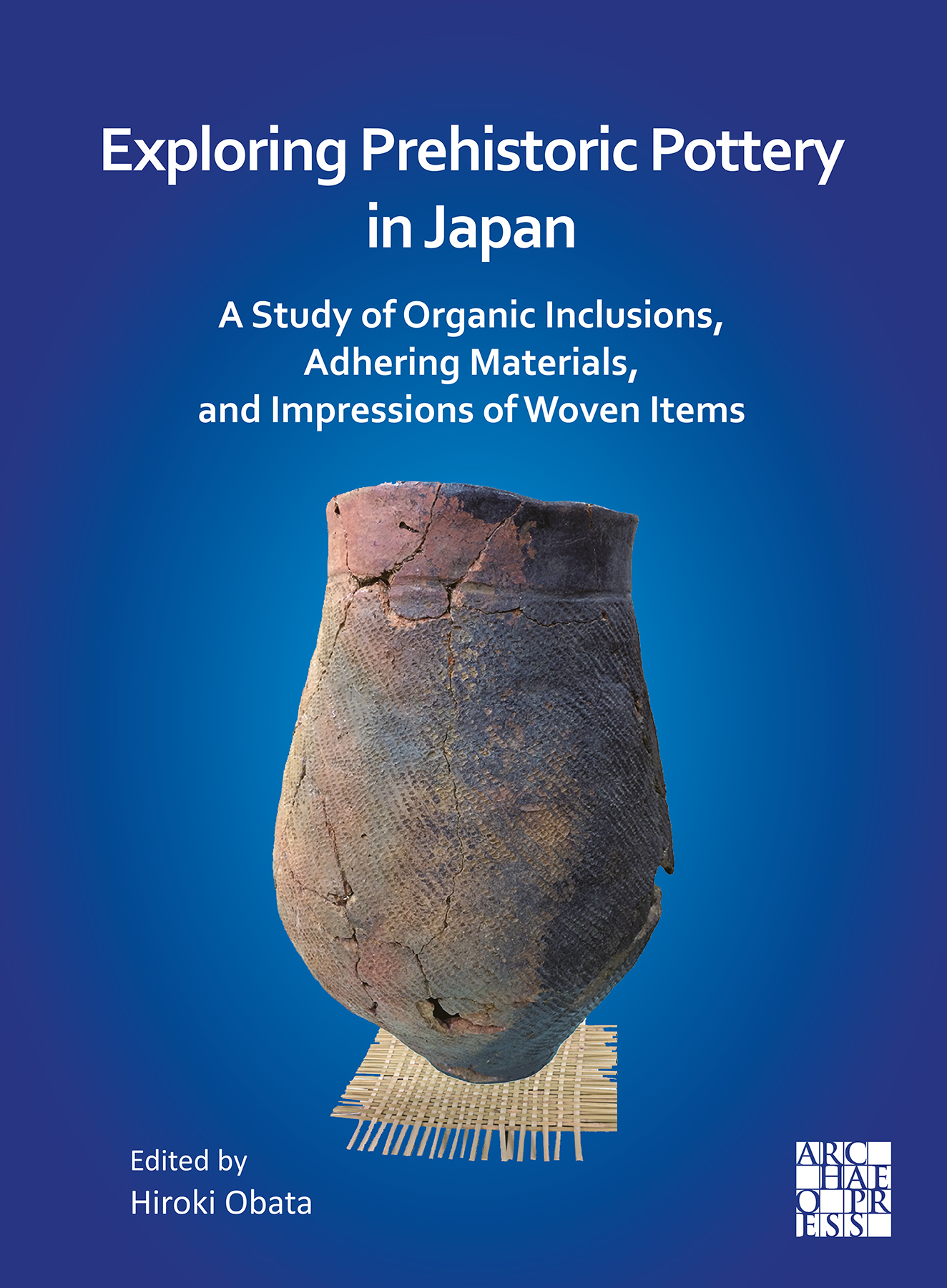
Download Sample PDF
H 276 x W 203 mm
166 pages
79 figures, 13 tables (colour throughout)
Published Oct 2026
ISBN
Paperback: 9781805833444
Digital: 9781805833451
Keywords
Prehistoric Japan; Ceramic Studies; Palaeoethnobotany
Exploring Prehistoric Pottery in Japan
A Study of Organic Inclusions, Adhering Materials, and Impressions of Woven Items
Edited by Hiroki Obata

Paperback
£30.00
Includes PDF
PDF eBook
(personal use)
£16.00
PDF eBook
(institutional use)
£30.00
 Add to wishlist
This volume explores how scientific analysis of Jōmon and Yayoi pottery reveals evidence of prehistoric life. Examining plant remains, tool impressions, food residues and carbonised traces, it demonstrates how “excavating inside the pottery” can reconstruct ancient lifeways, technologies and environments.
Contents
List of Figures and Tables
Acknowledgments
Preface – Hiroki Obata
Chapter 1: Prehistoric Pottery in Japan
Prehistoric pottery in the Japanese archipelago and its dating: The beginning of pottery and paddy-rice farming – Ken’ichi Kobayashi
Pottery and the spread of agriculture in Japan – Dai Kunikita
The emergence of cultivated plants in Japan: Seed impressions and carbonised seeds – Kei Ōta, Tatsuya Kokubo, Takashi Sano, Asako Yanagihara, Aya Manabe, Hiroki Obata
Chapter 2: Vegetal Temper and Pottery
Vegetal-tempered pottery in the Jōmon Period – Eastern Japan – Akinori Abe
Vegetal-tempered Pottery in the Jōmon Period -Western Japan – Kazutomo Mizunoe
Vegetal-tempered pottery of the world – Yastami Nishida
Plant temper identification methods – Yastami Nishida
Examination of vegetal temper through phytolith analysis – Tetsuro Udatsu
Identification of plant materials tempered in Jōmon pottery – Yastami Nishida, Mitsuo Suzuki, Kazutaka Kobayashi, Akinori Abe
Chapter 3: Macrobotanical Remains on and Inside Pottery Fabrics and Their Uses
Identification of woven baskets, mats and cords – Yuka Sasaki, Shuichi Noshiro, Kazutaka Kobayashi
Woven items as pottery impressions – Aya Manabe
Identification of materials adhering to pottery surfaces – Yuka Sasaki
Fishing nets in Jōmon Pottery – Hiroki Obata
Chapter 4: Various Impressions Found on Pottery
Detected seed impressions on pottery and their significance – Hiroki Obata
Various insect impressions – Hiroyuki Yoshitomi
‘Hidden’ shell middens and discoveries from shell impressions on pottery – Taiji Kurozumi
Proposal for ‘a pottery-impression house pestology’: Reconstructing prehistoric life and food from insect impressions – Hiroki Obata
Chapter 5: A Comprehensive Analytical Approach to Prehistoric Pottery
Artificial intelligence and pottery studies: Advancing classification approaches – Israel Mendonça
Pottery studies and comprehensive analytical approach – Hiroki Obata
Conclusion – Hiroki Obata, Ken’ichi Kobayashi, Dai Kunikita, Yuka Sasaki, Yoshiki Miyata, Akinori Abe, Yastami Nishida
About the Author
Hiroki Obata is an archaeologist specialising in archaeobotanical and archaeoentomological analysis based on organic inclusions found in Jōmon and Yayoi pottery. His research focuses on the history of plant cultivation and insect pests. He has achieved numerous breakthroughs – such as the discovery of cultivated soybeans from the Jōmon period and the oldest maize weevil in China – by adopting innovative research methods, including X-ray analysis of impressions on pottery. Since retiring from Kumamoto University, he has continued his ambitious research and remains a leading authority on pottery impressions in Japan and East Asia.
Archaeopress Publishing Ltd
First and Second Floor
13-14 Market Square
Bicester
Oxfordshire OX26 6AD
United Kingdom
Tel +44 (0) 1865 311914 | fax +44 (0) 1865 512231 | email info@archaeopress.com
