
Publishing Scholarly Archaeology since 1997
Publishing Scholarly Archaeology since 1997
Log in | My Account | Basket Twitter Facebook LinkedIn
Advanced Search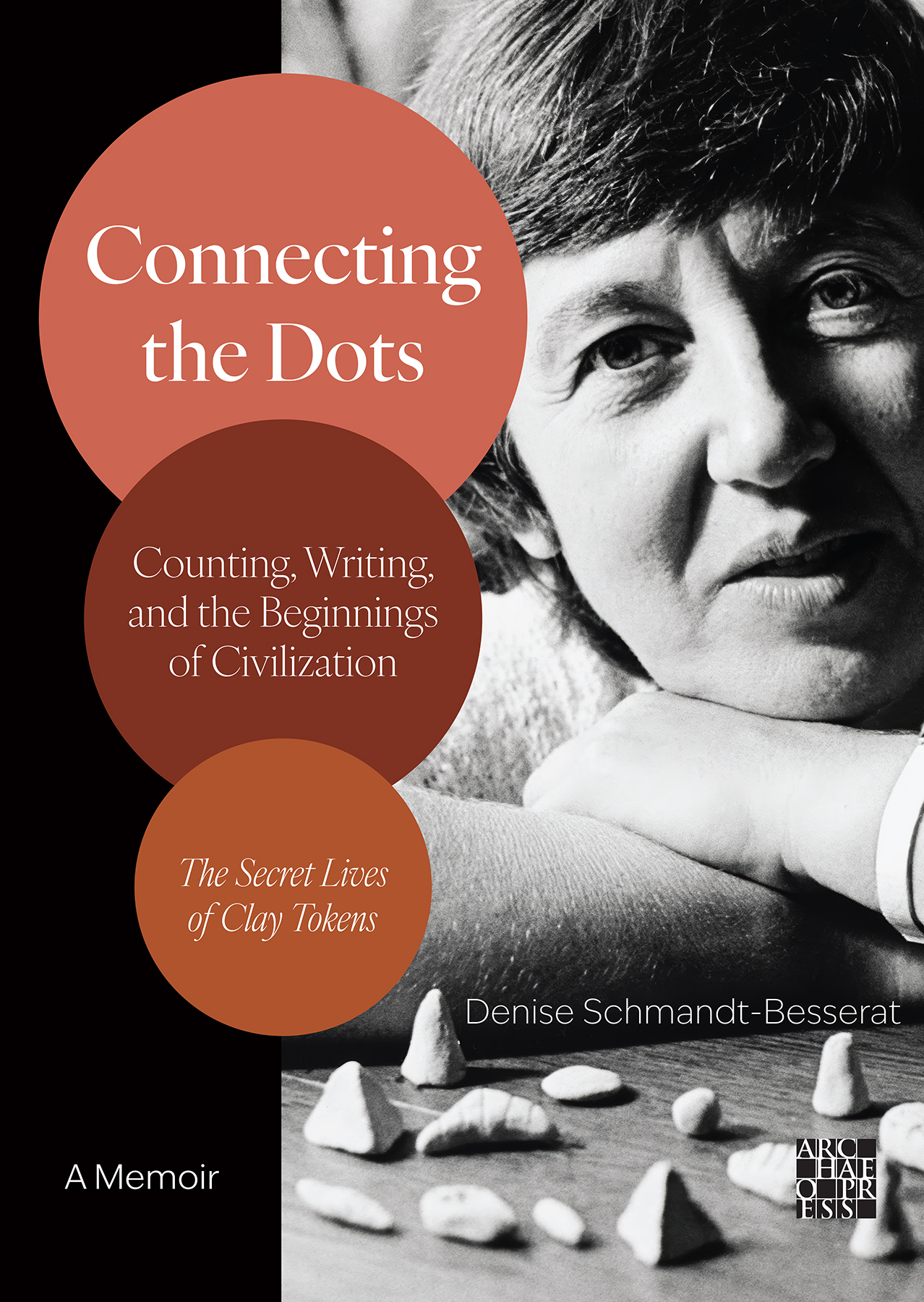
Download Sample PDF
H 245 x W 174 mm
178 pages
15 figures, 2 tables (colour throughout)
Published Jul 2026
ISBN
Paperback: 9781805833307
Digital: 9781805833314
Keywords
Denise Schmandt-Besserat; Archaeological Memoir; Counting; Writing; Clay Tokens; Civilization; Middle East; Neolithic
Related titles



Connecting the Dots: Counting, Writing, and the Beginnings of Civilization
The Secret Lives of Clay Tokens: A Memoir

Paperback
£25.00
Includes PDF
PDF eBook
(personal use)
£16.00
PDF eBook
(institutional use)
£25.00
 Add to wishlist
This memoir recounts Denise Schmandt‑Besserat’s pioneering research into Neolithic clay tokens, proposed as precursors to writing. Blending personal experiences with archaeological discovery, it traces her decades of fieldwork and presents her influential argument that early accounting practices helped give rise to writing and civilization.
Contents
List of Figures and Tables
Foreword – Marcella Frangipane
A Note from a Student – Michael Erard
Preface
Acknowledgments
Chapter 1: Longing for a Challenge. Paris, 1959–1965
Chapter 2: Becoming American. Boston, Massachusetts, 1965–1971
Chapter 3: The Right Place at the Right Time. Cambridge, Massachusetts, 1965–1971
Chapter 4: Excavating Museums. The Middle East, 1971
Chapter 5: One Step Forward, Two Steps Back. Texas, 1972
Chapter 6: Making a Splash. The University of Texas at Austin, 1972–2004
Chapter 7: Something Unexpected
Chapter 8: Tokens Revolutionize Neolithic Symbolism
Chapter 9: Paradigm Shift
Chapter 10: Bringing Order to Chaos
Chapter 11: Eureka!
Chapter 12: The Data Revolution
Denise Schmandt-Besserat Publications
Index
About the Author
Denise Schmandt-Besserat is Professor Emerita at the University of Texas at Austin. She is best known for introducing tokens to archaeology. Working alone, she documented that the artifacts were used continuously between 7500 and 3000 BC in a vast area of the ancient Middle East, extending from the Mediterranean to the Persian Gulf. She created the token typology of 16 types and over 300 subtypes, showing an evolution from plain-faced in the Neolithic, to bearing complex markings in the Bronze Age. Crucially, she identified the function of tokens as concrete counters used in a one-to-one correspondence, ultimately determining that the sketches of tokens on tablets contributed to history by becoming pictographs in the cuneiform script, the world’s first writing.
Archaeopress Publishing Ltd
First and Second Floor
13-14 Market Square
Bicester
Oxfordshire OX26 6AD
United Kingdom
Tel +44 (0) 1865 311914 | fax +44 (0) 1865 512231 | email info@archaeopress.com
