
Publishing Scholarly Archaeology since 1997
Publishing Scholarly Archaeology since 1997
Log in | My Account | Basket Twitter Facebook LinkedIn
Advanced Search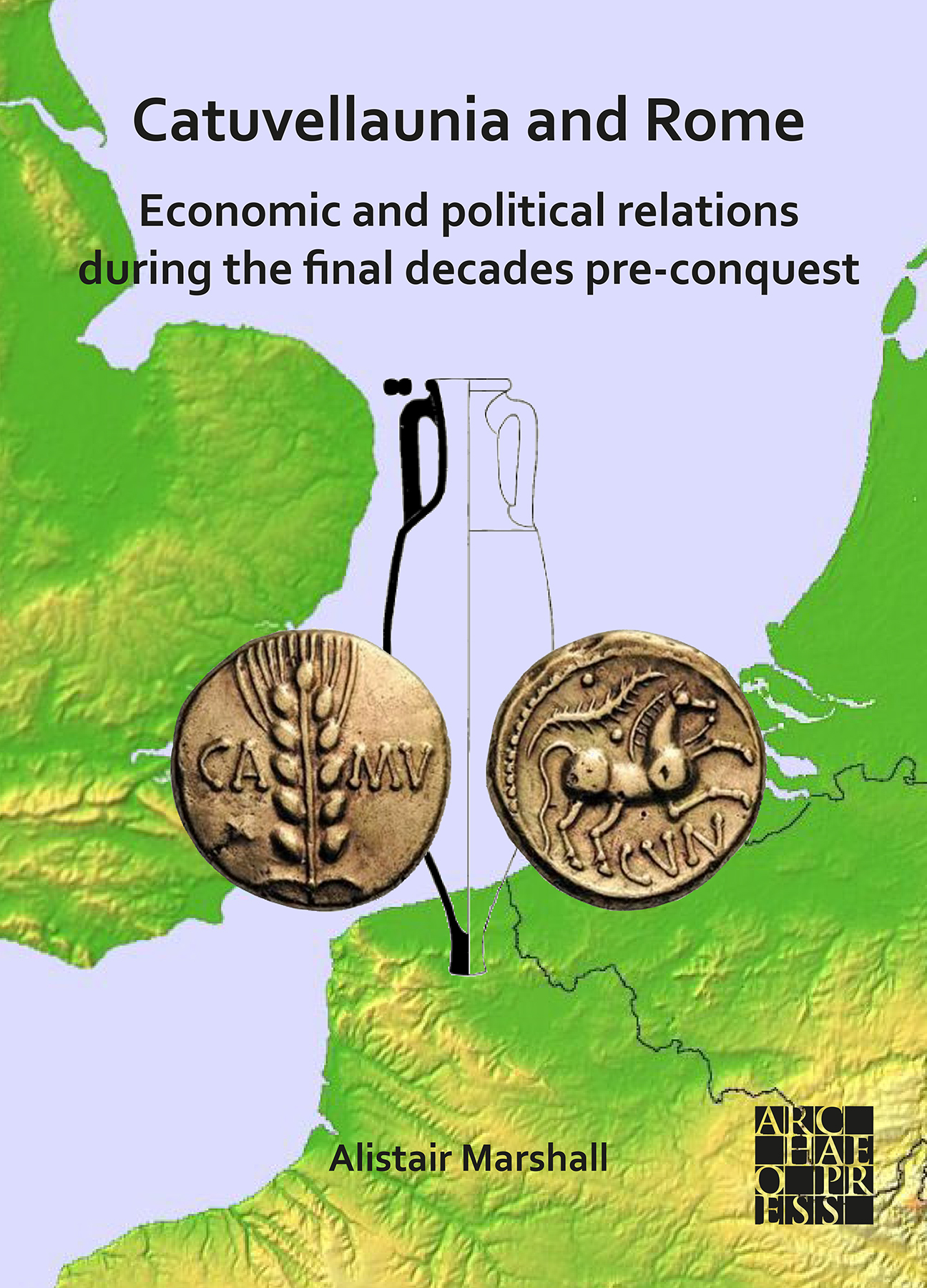
Download Sample PDF
H 276 x W 203 mm
518 pages
26 figures, 176 tables (minimal colour throughout)
Published Mar 2026
ISBN
Hardback: 9781805832492
Digital: 9781805832508
Keywords
Southeastern Britain; Iron Age; Roman; Exchange; Economy; Grain
Related titles


Catuvellaunia and Rome: Economic and Political Relations during the Final Decades Pre-conquest
The Role of Grain from Southeastern Britain and Its Potential for Maintenance of the Roman Military along the Frontier on the Rhine

Hardback
£98.00
Includes PDF
PDF eBook
(personal use)
£16.00
PDF eBook
(institutional use)
£98.00
 Add to wishlist
This study examines economic ties between Catuvellaunia and the Roman military in Gaul before AD 43, arguing that southern Britain’s grain surplus supplied Roman forces. Drawing on numismatic, textual, and archaeological evidence, it explores agriculture, trade logistics, tribal power, frontier supply, and Rome’s client‑kingdom politics.
Contents
Contents
Preliminary notes for readers
Keynote evidence
Summary
Section 1: Arable systems
Celtic fields: nature, distribution, and environmental background
Extensive arable blocs (EABs): a model for larger scale early agri-management
Division of the land: linear boundaries, and their field-systems
The agronomics of grain production during the Iron Age: a model-system
Section 2: Climatic considerations
Section 3: Hillforts from southern Britain: assessment of basic properties and distribution
Section 4: Tribal lineage and interaction
Section 5: Greater Catuvellaunia
Section 6: Tribal emblems on Celtic coinage from southern Britain
Section 7: Personal portraiture on Celtic coinage from southern Britain
Section 8: Kingship: the evidence from Celtic coins in southern Britain
Section 9: Militarism: changing projection: the evidence from Celtic coins in southern Britain
Section 10: Camulodunum: capital and major port of the Catuvellauni
Section 11: Oppida: Britain
Section 12: Oppida: Gaul
Section 13: Roman grain-consumption
Section 14: Southeastern Britain: Continental imports to southern Britain during the final Iron Age
Section 15: Ships and boats of later Iron Age, and earlier Roman date: evidence from northwestern Europe, and the Atlantic seaboard
Section 16: The northwestern coastal Atlantic: topography, navigation, and early resource-led voyaging
Section 17: Resources: trade in metals as motivation for development of major sea-routes from the Mediterranean to the northwestern Atlantic
Section 18: The Tayside Militarised Zone [TMZ]: logistics of bulk-supply to the Flavian salient in southeastern-coastal Caledonia
Section 19: The northern frontier-zone of Gaul along the Rhine: its initial development, and military requirements
Section 20: Grain-supply: problems and solutions
Section 21: Political considerations
Section 22: Cunobelinos: surviving the historical narrative
Section 23: Celtic coinage: Britain and Gaul: examples
Section 24: Literary sources
Section 25: Bibliography
About the Author
Alistair Marshall has carried out extensive excavation and prospection on prehistoric sites in southern Britain, with a strong interest in the latest Iron Age and early development of the Roman province.

Archaeopress Publishing Ltd
First and Second Floor
13-14 Market Square
Bicester
Oxfordshire OX26 6AD
United Kingdom
Tel +44 (0) 1865 311914 | fax +44 (0) 1865 512231 | email info@archaeopress.com
