
Publishing Scholarly Archaeology since 1997
Publishing Scholarly Archaeology since 1997
Log in | My Account | Basket Twitter Facebook LinkedIn
Advanced Search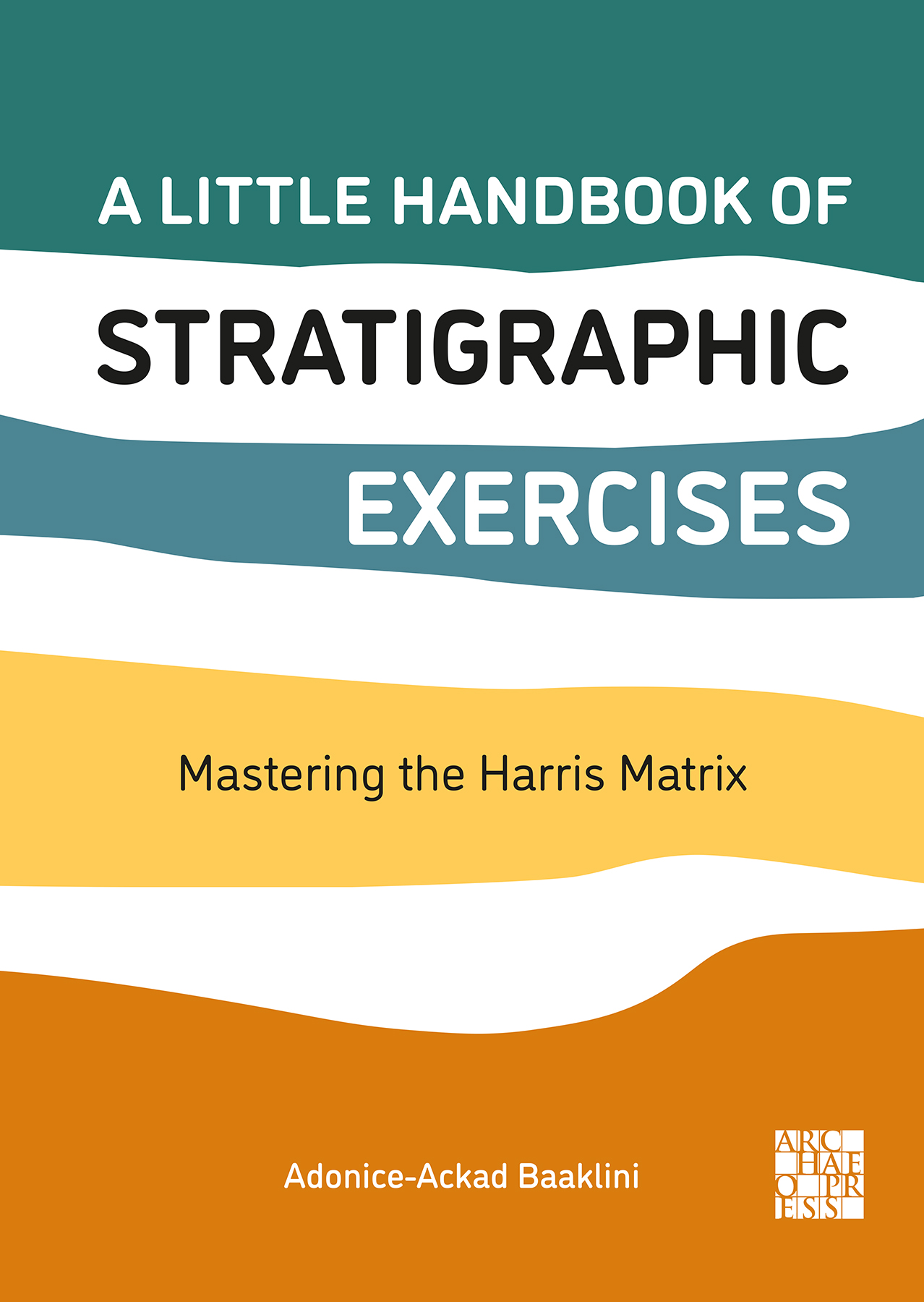
Download Sample PDF
H 245 x W 174 mm
66 pages
55 figures (colour throughout)
Published Mar 2026
ISBN
Paperback: 9781805832270
Digital: 9781805832287
Related titles


A Little Handbook of Stratigraphic Exercises
Mastering the Harris Matrix

Paperback
£19.99
Includes PDF
PDF eBook
(personal use)
£9.99
PDF eBook
(institutional use)
£19.99
 Add to wishlist
This handbook introduces stratigraphy and the stratigraphic matrix, offering theory followed by graded exercises that teach readers to build matrices from archaeological sections. With solutions and explanations, it serves as an accessible, practical guide for archaeology students and field professionals.
Contents
List of Figures
Foreword
How to use this book
Chapter 1. Introduction
1. What is archaeological stratigraphy?
2. The rules of stratigraphy
3. Stratigraphic units (SU)
4. Analysing and presenting stratigraphy: the matrix
5. References
6. Selected bibliography (in chronological order, by most recent)
Chapter 2. Exercises
Exercise 1: Simple succession of layers
Exercise 2: Simple succession of layers 2
Exercise 3: Large pit
Exercise 4: Large pit 2
Exercise 5: Posthole
Exercise 6: Postholes
Exercise 7: Foundation wall and wall with backfill on one side
Exercise 8: Foundation wall and wall with backfill on either side
Exercise 9: ‘Trench build’ foundation wall and wall
Exercise 10: Collapsed wall
Exercise 11: Canalisation
Exercise 12: Arabian-style earth architecture
Exercise 13: Mesopotamian-style architecture
Exercise 14: Prehistoric settlement
Exercise 15: Multi-period site
Exercise 16: Traditional houses: reuse and conservation
Exercise 17: North American pit house
Exercise 18: Artisanal area
Exercise 19: Pottery kiln
Exercise 20: Mediterranean mountainous site
Exercise 21: Prior unsupervised interventions at an archaeological site
Exercise 22: Anglo-Saxon building
Exercise 23: Multi-period rural site
Exercise 24: Industrial archaeology
Exercise 25: Building archaeology
Chapter 3. Explanations and comments on the exercises
Exercise 1 (explanation): Simple succession of layers
Exercise 2 (explanation): Simple succession of layers 2
Exercise 3 (explanation): Large pit
Exercise 4 (explanation): Large pit 2
Exercise 5 (explanation): Posthole
Exercise 6 (explanation): Postholes
Exercise 7 (explanation): Foundation wall and wall with backfill on one side
Exercise 8 (explanation): Foundation wall and wall with backfill on two sides
Exercise 9 (explanation): ‘Trench build’ foundation wall and wall
Exercise 10 (explanation): Collapsed wall
Exercise 11 (explanation): Canalisation
Exercise 12 (explanation): Arabian-style earth architecture
Exercise 13 (explanation): Mesopotamian-style architecture
Exercise 14 (explanation): Prehistoric settlement
Exercise 15 (explanation): Multi-period site
Exercise 16 (explanation): Traditional houses: reuse and conservation
Exercise 17 (explanation): North American pit house
Exercise 18 (explanation): Artisanal quarter
Exercise 19 (explanation): Pottery kiln
Exercise 20 (explanation): Mediterranean mountainous site
Exercise 21 (explanation): Prior unsupervised interventions at an archaeological site
Exercise 22 (explanation): Anglo-Saxon building
Exercise 23 (explanation): Multi-period rural site
Exercise 24 (explanation): Industrial archaeology
Exercise 25 (explanation): Building archaeology
About the Author
Adonice-Ackad Baaklini gained his PhD in Near Eastern Archaeology from the Sorbonne (2019), and has extensive experience in commercial and rescue archaeology. He has worked for several companies and institutions as a professional archaeologist, eventually reaching the positions of field director, scientific coordinator, and principal investigator. His responsibilities have included the training of young field archaeologists, including matrix composition.
Archaeopress Publishing Ltd
First and Second Floor
13-14 Market Square
Bicester
Oxfordshire OX26 6AD
United Kingdom
Tel +44 (0) 1865 311914 | fax +44 (0) 1865 512231 | email info@archaeopress.com
