
Publishing Scholarly Archaeology since 1997
Publishing Scholarly Archaeology since 1997
Log in | My Account | Basket Twitter Facebook LinkedIn
Advanced Search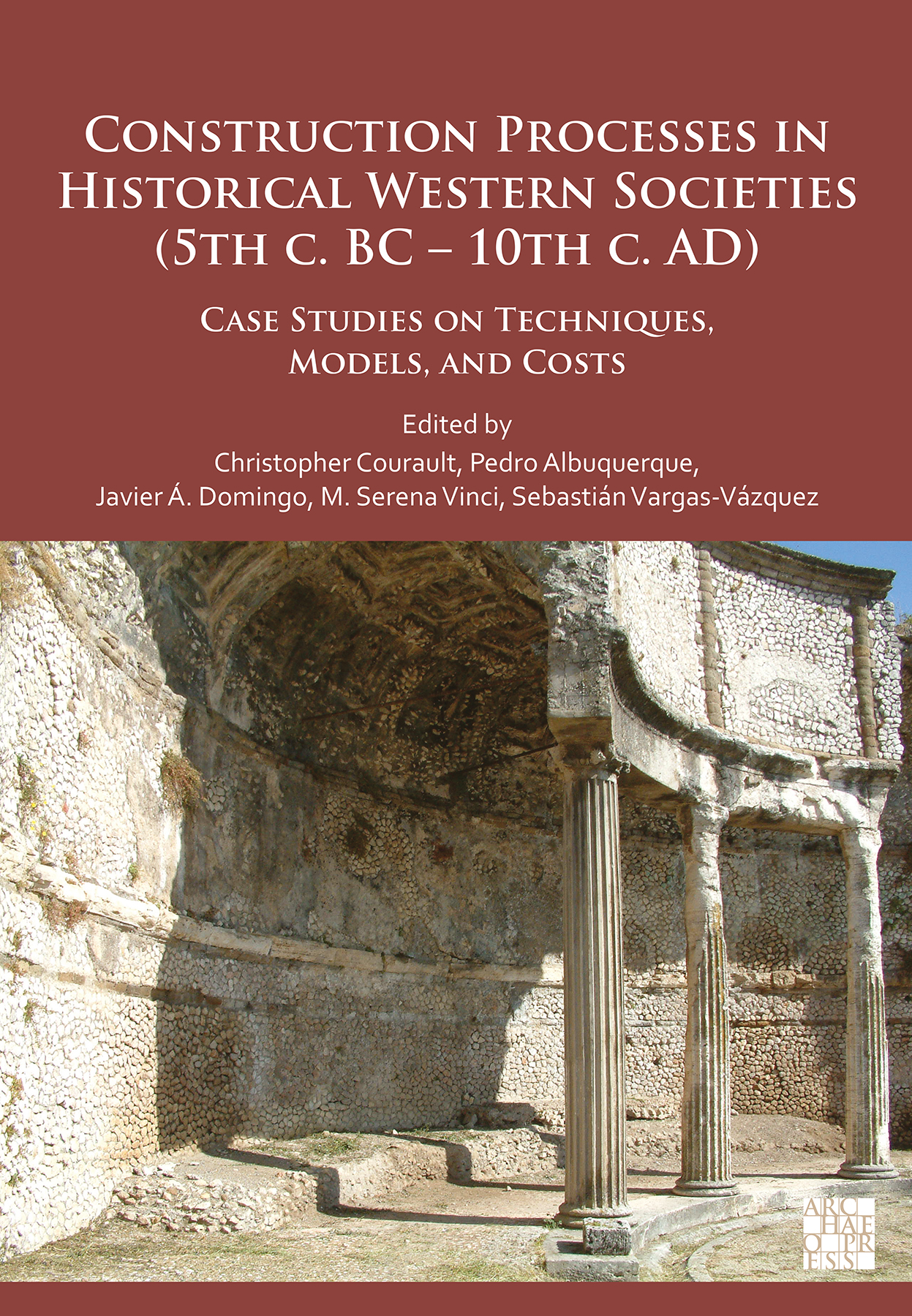
Download Sample PDF
H 290 x W 205 mm
320 pages
243 fiures, 2 tables (colour throughout)
Published May 2026
ISBN
Hardback: 9781805832256
Digital: 9781805832263
Keywords
Architecture; Construction; Roman Archaeology; Antiquity; Late Antiquity; Early Medieval
Related titles



Construction Processes in Historical Western Societies (5th c. BC – 10th c. AD)
Case Studies on Techniques, Models, and Costs
Edited by Christopher Courault, Pedro Albuquerque, Javier Á. Domingo, Maria Serena Vinci, Sebastián Vargas Vázquez

Hardback
£65.00
Includes PDF
PDF eBook
(personal use)
£16.00
PDF eBook
(institutional use)
£65.00
 Add to wishlist
This volume explores how ancient and early medieval societies sourced, crafted, transported, and reused construction materials. Through interdisciplinary studies—archaeology, geology, economics, and architecture—it examines supply networks, quarrying, workshops, long‑distance trade, and spolia, offering new methods and future research directions.
Contents
About the Author
Christopher Courault holds a PhD in archaeology and is a member of the research group Antiguas Ciudades de Andalucía (University of Córdoba). The focus of his research is the chaîne opératoire, construction time and costs, with particular attention to methodological revision and the social impact of major public works, including ancient urban fortifications.
Pedro Albuquerque is currently a distinguished researcher (Emergia) and lecturer in the department of Prehistory and Archaeology (University of Seville). He is a member of several research groups (HUM-152, De la Turdetania a la Bética) and institutions, such as the Centre for Global Studies (Aberta University, Portugal), CIAC (University of the Algarve, Portugal) and Uniarq (University of Lisbon, Portugal).
Javier Á Domingo is Professor of Christian Archaeology at the Pontifical University of the Holy Cross. Through several postdoctoral fellowships, he has undertaken various research activities at the University of Rome ‘La Sapienza’ and the Escuela Española de Historia y Arqueología in Rome. His studies are focused on Roman and late Roman architectural decoration, in addition to developing a methodology for calculating the economic costs of construction in the ancient world.
Maria Serena Vinci is an Assistant Professor of Classical Archaeology in the Department of Prehistory and Archaeology at the Universidad Nacional de Educación a Distancia (UNED), Madrid. Her research focuses primarily on Roman architecture and construction, with particular emphasis on the relationship between quarries and monuments. One line of investigation is on the use of epigraphic marks and carving guide-lines, understood as material evidence of planning, design, and construction processes.
Sebastián Vargas-Vázquez is a Professor in the Department of Prehistory and Archaeology at the University of Seville. His research focuses on the study of Roman mosaics, with a particular emphasis on the analysis of geometric designs and the socio-professional organization of musivarii (mosaic) workshops. Currently, his archaeological work is centered on the Roman city of Italica (Santiponce, Seville), where he analyses its architecture – primarily public buildings – and its integration within the city’s urban fabric.
Archaeopress Publishing Ltd
First and Second Floor
13-14 Market Square
Bicester
Oxfordshire OX26 6AD
United Kingdom
Tel +44 (0) 1865 311914 | fax +44 (0) 1865 512231 | email info@archaeopress.com
