
Publishing Scholarly Archaeology since 1997
Publishing Scholarly Archaeology since 1997
Log in | My Account | Basket Twitter Facebook LinkedIn
Advanced Search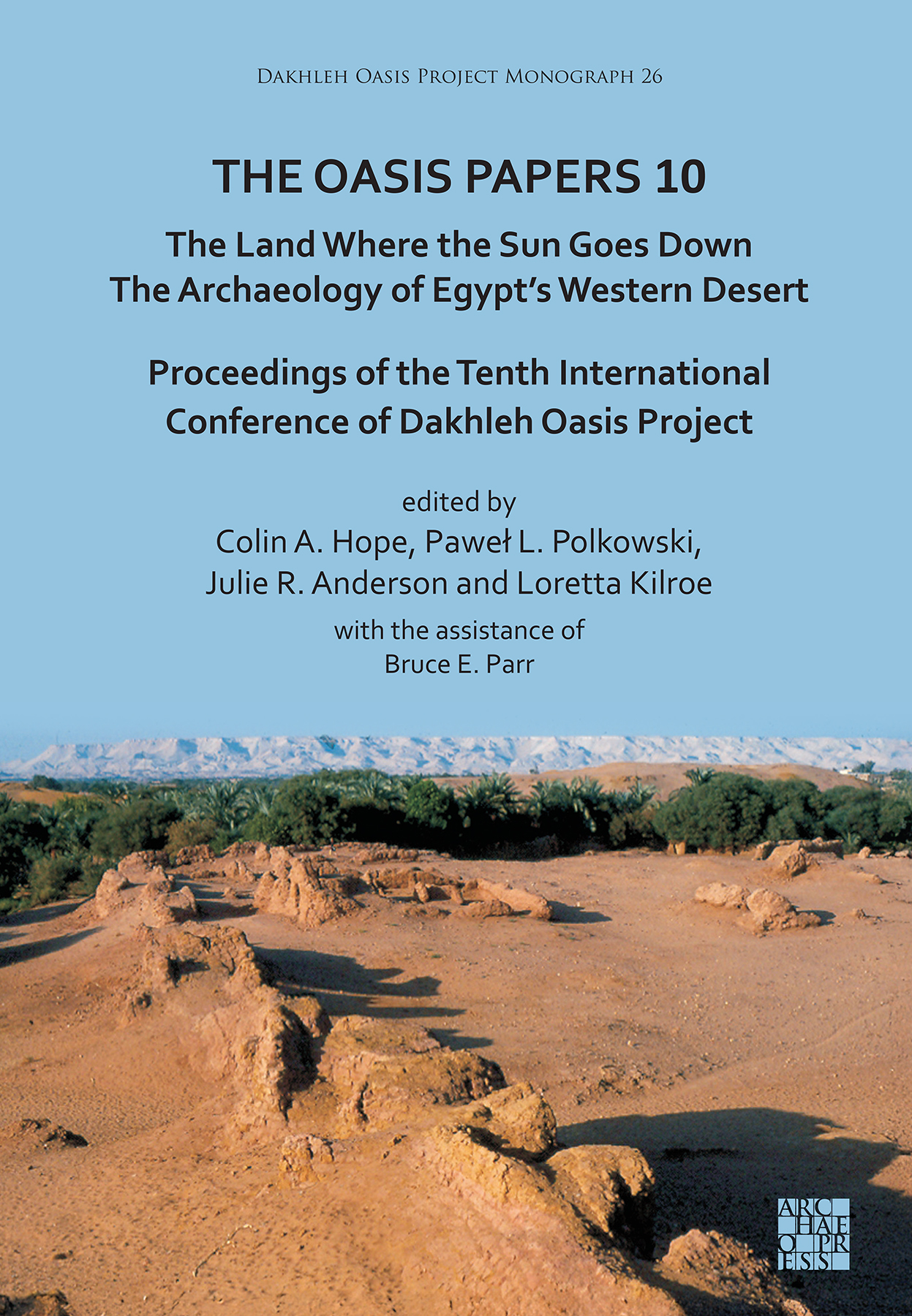
Download Sample PDF
H 290 x W 205 mm
350 pages
Illustrated throughout in colour and black & white
Published Dec 2025
ISBN
Paperback: 9781805832232
Digital: 9781805832249
Keywords
akhleh Oasis; Kharga Oasis; Rock Art; Pharaonic Writing; Pharaonic Iconography; Pharaonic Temples; Churches; Ceramics; Architectural Adornment; Human Subsistence Patterns; Kellis; Mut al-Kharab; Amheida; el-Deir; Early Christianity
Related titles


Dakleh Oasis Project Monograph 26
The Oasis Papers 10: The Land Where the Sun Goes Down. The Archaeology of Egypt’s Western Desert
Proceedings of the Tenth International Conference of Dakhleh Oasis Project
Edited by Colin A. Hope, Paweł L. Polkowski, Julie R. Anderson, Loretta Kilroe
Associate Editor Bruce E. Parr

Paperback
£75.00
Includes PDF
PDF eBook
(personal use)
£16.00
PDF eBook
(institutional use)
£75.00
 Add to wishlist
This volume presents 19 papers from the Tenth International Conference of the Dakhleh Oasis Project, offering new research on Egypt’s Western Desert from prehistory to Late Antiquity. Topics include archaeology, rock art, settlements, temples, Christianity, heritage management, and environmental change across Dakhleh and Kharga.
Contents
Preface
Conference Programme
Managing the Preservation of Archaeological Sites and Heritage in Parallel with Achieving the Goals of Sustainable Development – Lamiaa Sayed Abdallah
The Church at Dayr Abu Matta, Dakhleh Oasis, Egypt and its Implication for Dating Triconch Churches in the Nile Valley and Beyond – Gillian E. Bowen and Christian Turney
Plaster Architectural Decoration from Domestic Contexts at Amheida – Roberta Casagrande-Kim
Eastern Desert Signposts and Western Desert Annotations: Early Hieroglyphic Rock Inscriptions in Upper Egypt – John Coleman Darnell
Christian Archaeology in Kharga Oasis: Recent Fieldwork – Victor Ghica
The ‘Cult Hill’ of El-Deir: Reflections on the Typology of Temples in the Kharga Oasis – Arnault Gigante and Gaëlle Tallet
Mut al-Kharab: The Archaeology of the Central Temple Area – Colin A. Hope
The Abandonment of Kellis: Further Reflections – Colin A. Hope, Gillian E. Bowen and Iain Gardner
A Stela for Harendotes from Amheida and the Changing Views on Horus and Seth in the Southern Oasis – Olaf E. Kaper
Stratified Late Antique Ceramics from al-Qasr – Paul N. Kucera
Footsteps in the Rock: Graffiti on an Outcrop in North Kharga – Nikolaos Lazaridis and Salima Ikram
The So-Called ‘Water Mountain’ Symbol in the Chufu Region, Egyptian Western Desert: New Insights and Interpretations – Nourhan Moustafa Ahmed
Lighting in Trimithis: Lamps from Late Roman Domestic Contexts – Marina Maria Serena Nuovo
From the Valley, From the Desert: The Iconography of Seals from Balat in the Late Third Millennium – Laure Pantalacci
Irrigated Stones: Interpreting Enigmatic Petroglyphs from the Western Desert – Paweł L. Polkowski
A Reinterpretation of a Petroglyph Group at Djedefre’s Water Mountain and Other Early Boat Petroglyphs in Areas Adjacent to the Western Oases – Rita Simon
The Spread of Domesticates across Egypt and their Potential Impact on Indigenous Wild Animal Species: Placing Dakhleh in a Wider Context – Juliet V. Spedding, Salima Ikram, Ignacio A. Lazagabaster, Chris Thomas and Jakob Bro-Jørgensen
Blocks from a Late Period or Early Ptolemaic Period Tomb near Mut in Dakhleh Oasis – Günter Vittmann
Dayr Mustafa Kashif and the Episcopate of Oasis Magna in Late Antiquity – Rhiannon Williams
The Dakhleh Oasis Project Monographs
About the Author
Colin A. Hope and Paweł L. Polkowski are members of the Dakhleh Oasis Project, while Julie R. Anderson and Loretta Kilroe represent the Department of Egypt and the Sudan at the British Museum. Hope is Senior Research Adjunct in the Department of Archaeology and Ancient History at Monash University and directs excavations in Dakhleh Oasis at Ismant al-Kharab and Mut al-Kharab; he is a founding member of the Dakhleh Oasis Project and focuses upon settlement archaeology in Dakhleh. Polkowski is the current director of the Project and head of its Petroglyph Unit. He is the senior custodian at the Poznań Archaeological Museum and an adjunct at the Institute of Archaeology and Ethnology, Polish Academy of Sciences. Julie Anderson is Curator for Egypt and the Sudan with a major interest in the Kushite and Saite Periods, while Loretta Kilroe is the IB Curator for Sudan and Nubia.
Archaeopress Publishing Ltd
First and Second Floor
13-14 Market Square
Bicester
Oxfordshire OX26 6AD
United Kingdom
Tel +44 (0) 1865 311914 | fax +44 (0) 1865 512231 | email info@archaeopress.com
