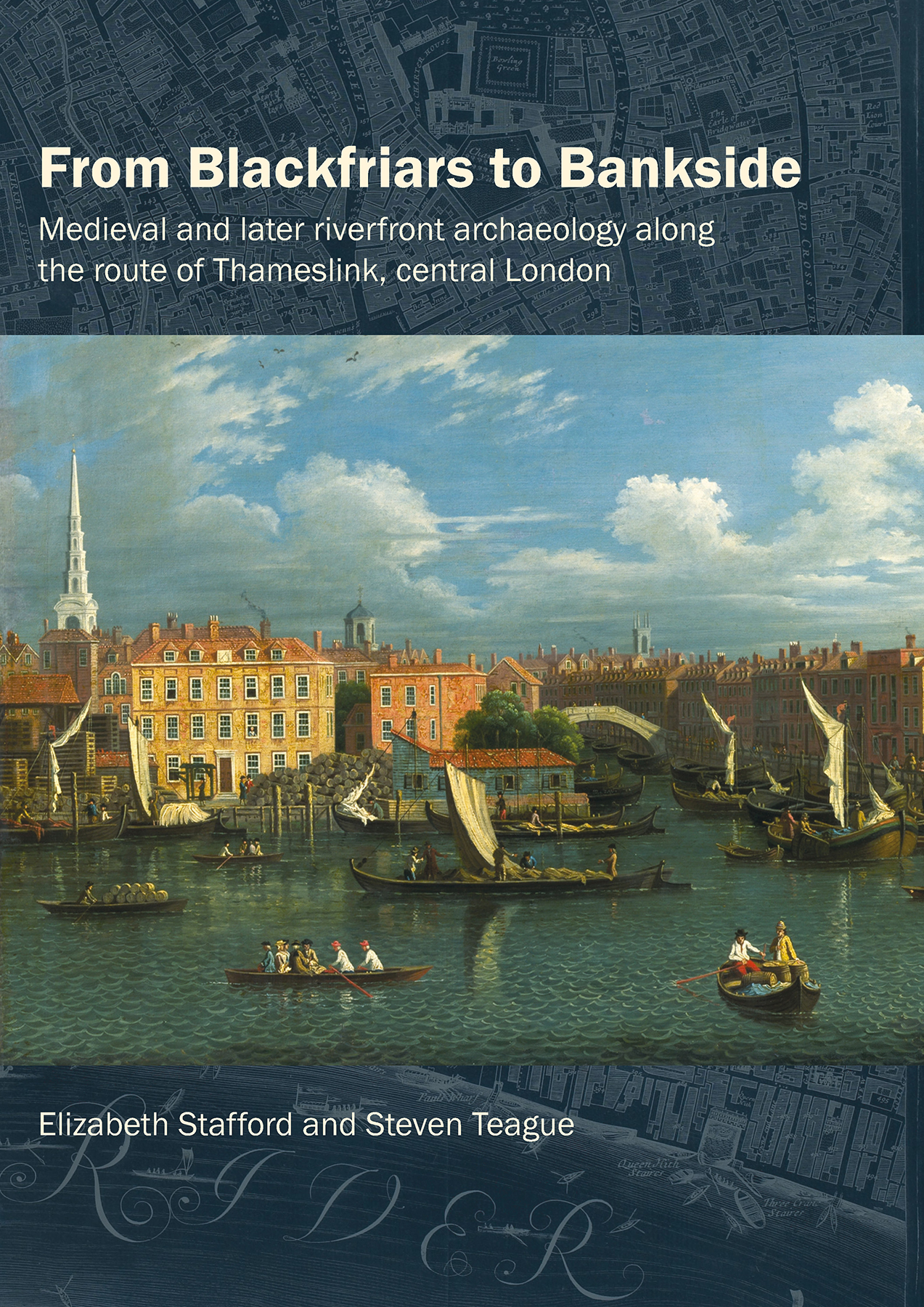
Thameslink Monograph Series 4
From Blackfriars to Bankside: Medieval and Later Riverfront Archaeology Along the Route of Thameslink, Central London
By Elizabteh Staford, Steven Teague

Hardback
£12.00
Add to basket
 Add to wishlist
Geoarchaeological and excavation work for the Thameslink upgrade revealed Roman foreshore activity at the mouth of the Fleet, Saxon–post‑medieval alluvial sequences, and medieval to early modern riverfront structures at Blackfriars, including a 14th‑century friary wall and later wharfing tied to land reclamation.
READ MORE
The Thameslink infrastructure upgrade involved the construction of new commuter stations on the banks of the River Thames at Blackfriars North within the City of London and Blackfriars South in the Borough of Southwark, with extension to platforms and the installation of solar panels along the length of the railway bridge. The new Blackfriars Station is the first in London to span the entire width of the River Thames, and the first new station to be built in this area for 120 years. This volume presents the results of geoarchaeological investigations undertaken on both sides of the river and archaeological excavations carried out on the north bank. Traditional archaeological trenching to investigate the historic foreshore and underlying alluvial layers was impractical in much of the project area due to extensive deposits of modern rubble, foundations and the density of live services, so the initial stages of fieldwork involved geoarchaeological evaluation. This work, undertaken by MOLA in 2009 and 2010, involved monitoring of geotechnical boreholes and trial pits at Blackfriars North, and the drilling of several boreholes for archaeological purposes. The cores of boreholes successfully drilled to bedrock were extruded and assessed. The second phase of fieldwork involved the drilling of boreholes on the south bank in mitigation of construction works. A programme of mitigation excavation, confined to the north bank of the River Thames, was carried out during construction works within the footprint of the new Blackfriars Station North. The construction of a sedimentary deposit model that spans the current channel of the Thames was based on the results of the geoarchaeological investigations on both sides of the river. The absence of evidence for any prehistoric activity is probably the result of recent erosion. However, gravel deposits infilling the edges of a large bedrock hollow on the confluence of the Rivers Thames and Fleet at Blackfriars North produced possible evidence of waterside activity dating to the Roman period. Previous discoveries of the ‘Blackfriars I’ and other Roman wrecks in the vicinity suggest that ships docked at the mouth of the Fleet, a major navigable river during that period. Organic material from alluvial deposits overlying the gravel terrace on the south bank produced Middle Saxon and later radiocarbon dates, and provide insights into the tidal nature of the river and of foreshore land use at Blackfriars South from Saxon times to the modern day. The microfossil and mollusc evidence from these sediments suggest that this location close to a tidal head was a mixed environment of freshwater with localised brackish saltmarsh and tidal flats fronting the Thames. Pollen species and insect remains indicate that deciduous and coniferous woodland were present in the wider vicinity. The surrounding landscape was cultivated and managed, with areas of reclamation from about the 13th century onwards, with marshy areas punctuated with arable fields and pasture and gardens planted with exotic trees. The alluvial sequences of the north bank broadly resemble those from the Saxon alluvial deposits on the south bank, and also contained material typical of episodic dumping and reclamation activity on the foreshore during the 16th–17th centuries. Some of the uppermost samples yielded only freshwater microfossils associated with relatively modern detritus, including brick, coal, bone, and oyster shell, consistent with the post-medieval waterfront activity exposed in the excavation trenches. Archaeological excavation was restricted to three small trenches on the north bank of the river. Here the masonry and timber remains of a significant early 14th-century precinct wall (Structure 1) were discovered, associated with Blackfriars Friary, which gave the area its name. The wall was constructed on Roman foreshore gravels which contained fragments of 4thcentury pottery. The remnants of additional structures included a row of wood