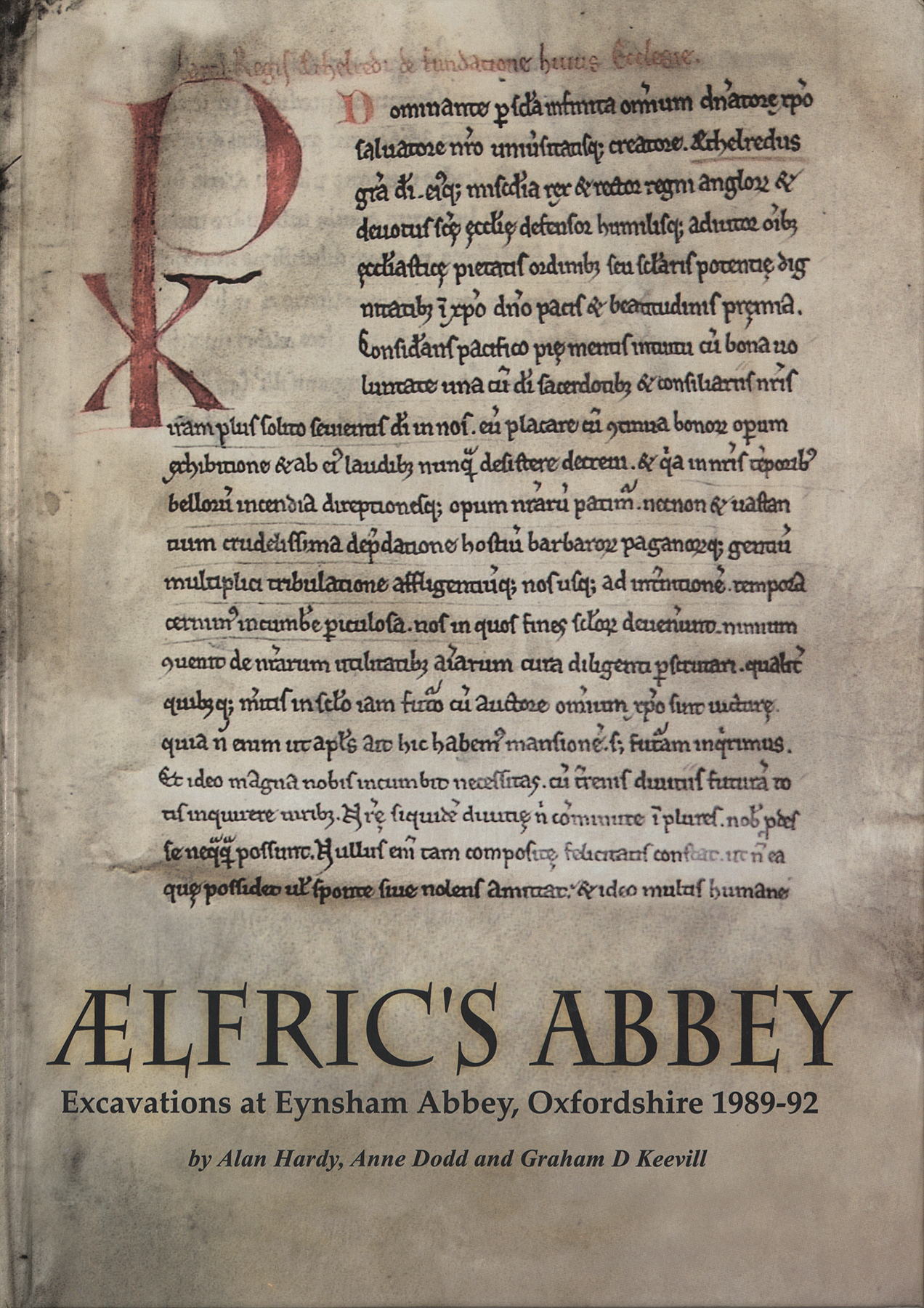
Thames Valley Landscapes Monograph 16
Aelfric’s Abbey
Excavations at Eynsham Abbey, Oxfordshire, 1989-92
By Alan Hardy, Anne Dodd, Graham Keevill

Hardback
£49.95
Add to basket
 Add to wishlist
A major report on excavations at Eynsham Abbey, Oxfordshire, tracing occupation from early Saxon settlement and minster to Benedictine abbey and post-Dissolution reuse. Archaeology, survey and documentary evidence illuminate the development and economy of a medieval religious house.
READ MORE
Oxford Archaeology excavated an area of approximately 1800 sq m within the inner ward or court of the precinct of Eynsham Abbey between 1989 and 1992. The excavation area straddled the modern churchyards of the Roman Catholic St Peter's Church and the Anglican St Leonard's Church, both of which were planning to extend their cemeteries. This factor was the immediate stimulus for the excavations, which were wholly funded by English Heritage.
Occupation of the site commenced with the construction of a large enclosure in the late Neolithic period. This is reported elsewhere. A hiatus of some 1500 years was followed by the establishment of an early Saxon settlement represented by a number of sunken-featured buildings and associated pits and hearths. This settlement was superseded by u more organised pattern of occupation, represented by timber halls and boundary ditches possibly associated with the minster church which documentary sources suggest was founded in the 7th or 8th century. In 1005 the minster was refounded as a Benedictine abbey, and substantial traces of some of its principal buildings were found. Following a period of instability after the Norman Conquest, the abbey was refounded in 1109. Buildings relating to this transitional period, and temporary structures from the early 12th century were found. The abbey prospered for most of the medieval period before the Dissolution in 1538-9. Precinct buildings revealed in the excavation included part of the Great Cloister (garth, lavatoria and the west and south walks), refectory, kitchens, cellars, domestic range and latrines. Some of these buildings were reused after the Dissolution. Also found were elements of the water supply and waste disposal systems. Extensive and significant assemblages of pottery, tile, architectural masonry, small finds, animal bone and carbonised environmental remains were recovered.
To augment the potential of the main excavation, a further programme of geophysical survey, evaluation and selected excavation work was carried out by Oxford Archaeology, or under their supervision, during 1997-8. The intention of the work was to study as much as possible of the abbey's inner and outer wards within the constraints of resources and the Scheduled Ancient Monument status of part of the precinct, in order to place the main abbey excavations in their context. The evidence from the excavations both major and minor - and the surveys, combined with a study of the varied documentary sources, have allowed a rare opportunity to study in depth the development and economy of a major religious house from its origins through to its demise.