Thames Valley Landscapes Monograph 2
The Prehistoric Landscape and Iron Age Enclosed Settlement at Mingies Ditch, Hardwick-with-Yelford, Oxon
The Windrush Valley, Volume 2
By Tim Allen, Mark Robinson

Paperback
£18.00
Add to basket
 Add to wishlist
Combines palaeoecological study with excavation of a Middle Iron Age enclosed settlement at Mingies Ditch in the Windrush Valley. Environmental evidence, structures, artefacts and organic ditch deposits reconstruct a pastoral floodplain community and its landscape setting.
READ MORE
A palaeoecological study was made of organic deposits from a series of channels on the floodplain of the river Windrush which ranged in date from Late Devensian to mid Holocene. It showed the replacement of tundra vegetation with open woodland at the start of the Holocene and the ecological succession which had resulted in dense alder-dominated woodland covering the floodplain before 4500BC. There was no evidence from these deposits for human interference with the vegetation other than the recovery of small quantities of charcoal, although latest Palaeolithic and Mesolithic worked flints were found. Direct evidence of tree clearance around 850 BC was provided by the discovery of tree pits containing alder root charcoal.
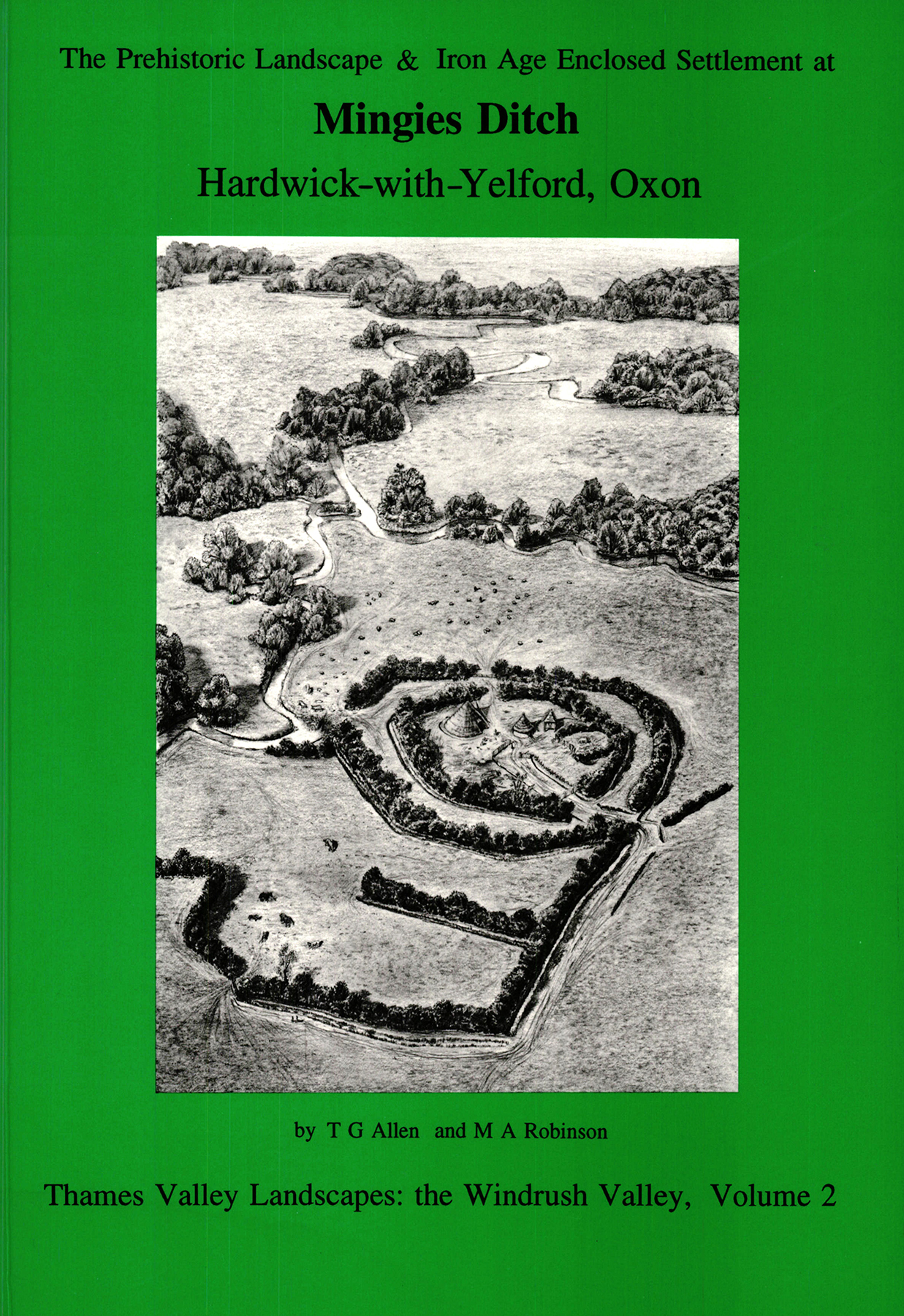
The excavation of an Iron Age settlement on the floodplain of the river Windrush in advance of gravel extraction was combined with detailed environmental archaeological investigations. The site consisted of a double-ditched enclosure and an attached paddock, the ditches and their upcast still showing on the ground as slight earthworks. The site proved to have only one phase of use dating to the Middle Iron Age c 380-110 bc. However, within this several stages of development could be distinguished involving five round-houses, five fourpost structures, several other assorted structures and a series of barriers dividing up the interior into separate functional areas. Of especial interest was the structural detail preserved in some of the houses in association with occupation spreads. The enclosure ditches contained extensive organic deposits which have enabled the environment to be reconstructed in detail. The site seems to have been established as a pioneer settlement on previously unenclosed land in a small peninsula of scrub and pasture surrounded by streams on three sides. The enclosure was protected by hedges alongside the outer and inner ditches and was positioned to use a bow of the Mingies Ditch stream, which ran down its W side, as a watering place. The economy of the site was predominantly pastoral, possibly with some emphasis on horses, and the area between the ditches was probably used to keep animals in overnight. Charred cereal remains were present but there was no evidence for cultivation of the floodplain. Occupation was confined to the area inside the inner ditch. The inhabitants probably comprised only one or two households carrying out a standard range of domestic activities: weaving, grinding corn, a little metalwork and other activities involving the use of fire. Pottery was locally made, and the site appears to have been of low status. Abandonment after 50-100 years may have been partly due to a rise in the water table. There was then a hiatus before the area was reoccupied, when ditched boundaries from a nearby first century AD settlement on the edge of the gravel terrace cut across the forgotten Iron Age site. The site was subsequently sealed beneath a thin layer of alluvium.