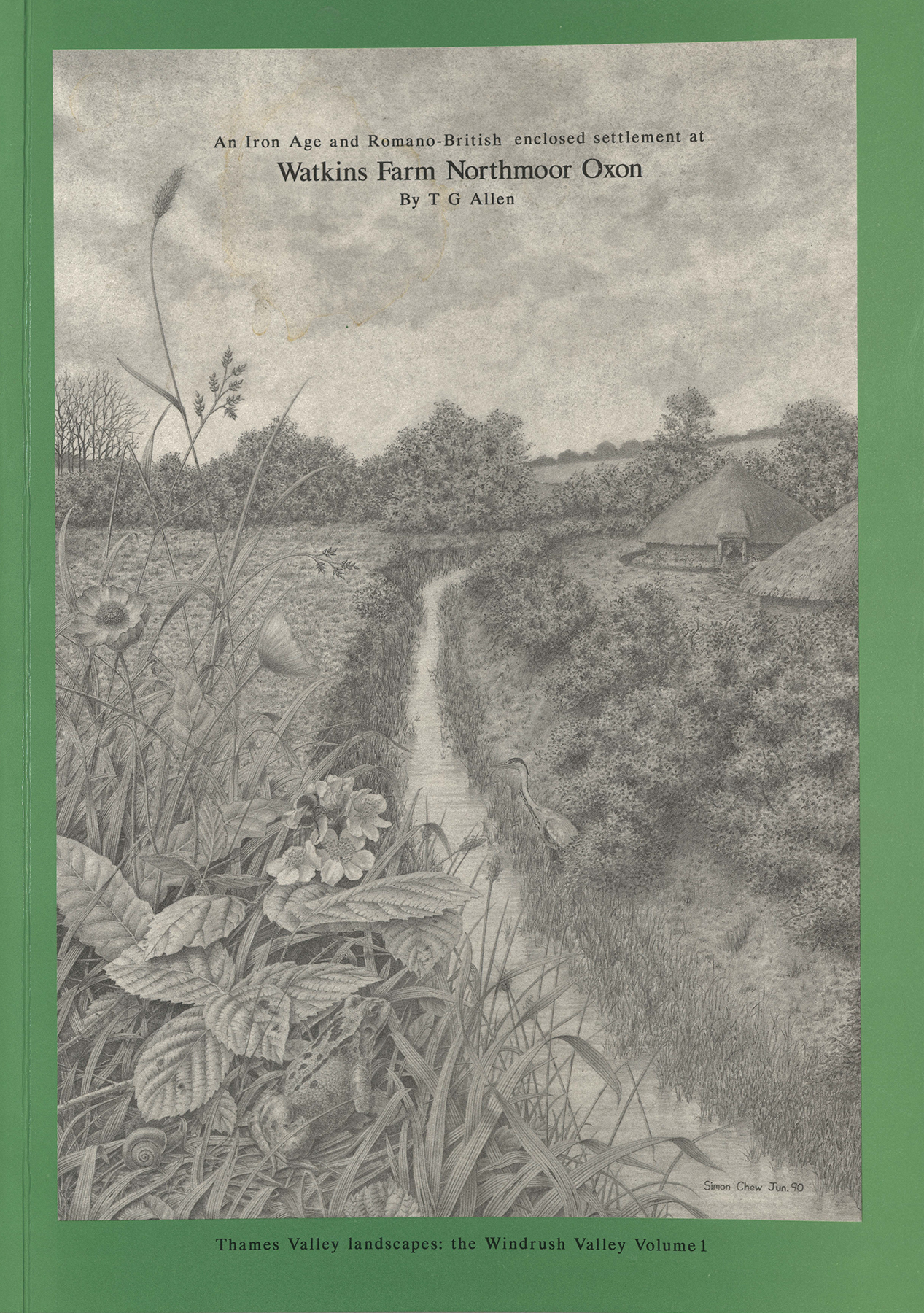
Thames Valley Landscapes Monograph 1
An Iron Age and Romano-British Enclosed Settlement at Watkins Farm, Northmoor, Oxon
The Windrush Valley, Volume 1
By Tim Allen
Contributions by Sheila Raven, Elaine Morris, John Shepherd, Wendy Page

Paperback
£18.00
Add to basket
 Add to wishlist
Reports excavations at Watkins Farm, Northmoor, revealing a Middle Iron Age enclosed settlement and later Romano-British enclosures in the Windrush Valley. Waterlogged features, wells, pottery, animal bone and environmental evidence illuminate settlement, economy and landscape use.
READ MORE
Excavation of a Middle Iron Age enclosed settlement and Romano-British enclosures was carried out in advance of gravel extraction over three short seasons between June 1983 and January 1985. The site was not visible from aerial photographs, and first appeared during topsoil stripping by ARC Ltd. It lay on low-lying Frist Gravel Terrace E of the river Windrush (SP 426035) and the occupied areas lay upon a slightly higher gravel island than the surrounding land. Because of the high water table waterlogged remains were preserved in the deepest features.
Within the main settlement, Site A, the Iron Age settlement consisted of at least four small penannular enclosures, probably surrounding houses, all of which had more than one phase of use and several of which may have been contemporary. There were only two pits and no definite four-post structures, and the environmental evidence suggests that arable agriculture was not practised close to the site. The animal bones indicate predominantly cattle, horses and sheep; a high percentage of horses compared with other sites in the region suggests horse-breeding was a significant part of the economy. A relict stream course just S of the settlement may have been active at this time; there was also a shallow well c.2.0m deep within the main enclosure. Pottery and C14 dates suggest that occupation fell entirely within the later part of the Middle Iron Age, most probably between 250 BC and 50 BC. After a break in occupation the main Iron Age enclosure was reused in the later 1st/early 2nd century AD. A series of ditch circuits was dug respecting the main enclosure , and these were followed by a trackway and field system incorporating a subrectangular enclosure which cut across but overlay the main Iron Age enclosure. There was a succession of these subrectangular enclosures, apparently dating between the early 3rd century and the mid 4th century AD. The only features within the Romano-British enclosures were a few shallow pits and short lengths of gully, a scatter of postholes and one or two wells. The density of Romano-British pottery suggests that domestic occupation lay close by, but there was no firm evidence for structures within the excavated area.
Two hundred metres to the NE another area of Romano-British enclosure boundary ditches and wells was uncovered (Site B). The pottery indicates 2nd-century occupation close by, with much smaller scale activity in the 3rd and 4th centuries AD. Again, no evidence for structures was recovered, though one probable domestic enclosure was seen. In the medieval period Site A was cultivated. Finds from one or two of the wells suggest these may have been medieval and that there was an early 11th-12th century phase of pasture before arable cultivation began. On Site B one pit of the 11th-12th century was found, and several diches forming rectilinear enclosures were possibly of this date.