This volume reports a 3rd–4th‑century Romano‑British cemetery of 69 burials and an early Anglo‑Saxon settlement with post‑built and sunken‑featured buildings at Barrow Hills, Radley. The findings illuminate burial organisation, settlement layout, and continuity of use beside earlier prehistoric monuments.
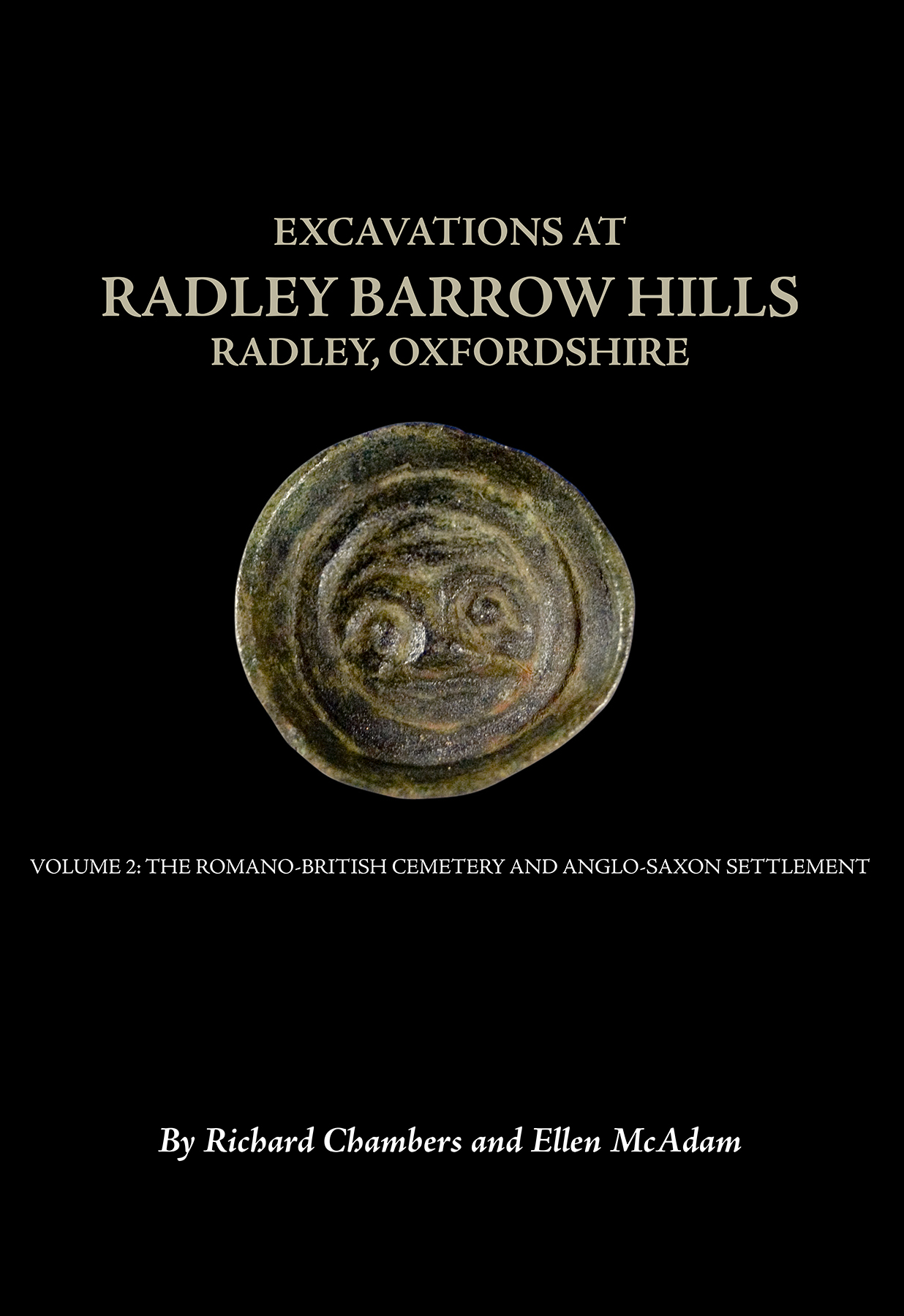
Between 1983–5 excavation of 3.5 ha of gravel terrace at Barrow Hills, Radley, recorded three distinct phases of activity on a site whose existence was known from aerial photography: a prehistoric monument complex, a Romano-British cemetery and an early Anglo-Saxon settlement. The prehistoric features are reported on in Volume 1 (Barclay and Halpin, 1999). This report, Volume 2, deals with the Romano-British cemetery and Anglo-Saxon settlement. The Romano-British cemetery consisted of 69 burials dating to the 3rd and 4th centuries and occurring as both distinct burials groups and isolated graves. There were 57 inhumations and 12 cremations, 6 of which were within a square ditched enclosure. The skeletal assemblage was well preserved. The report considers the evidence for the organisation of the cemetery, orientation, age and sex, body position, decapitation, coffins, inhumation versus cremation, grave goods, chronology and location. It is likely that the area of the prehistoric barrow cemetery was not cultivated in the Romano-British period, and the cemetery may have been laid out along the line of a north-south trackway. It probably served as the cemetery for the adjacent settlement site of Barton Court Farm (Miles 1986), and the cemetery groupings are compared with the population models postulated for that site. The Anglo-Saxon settlement was represented by 22 post-built structures, 45 sunken-featured buildings, 2 inhumations, pits, fills of prehistoric barrow ditches and various other features. The settlement is dated by finds evidence to the 4th to early 7th centuries. The Anglo-Saxon features at Barton Court Farm, previously published in fiche, are also listed here. Chapter 3 describes the features and the evidence for their construction and use. Chapter 4 discusses the pottery assemblage, one of the largest excavated in England with a total weight of 127.62 kg. Chapter 5 deals with the small finds, and the environmental evidence is described in Chapter 6. Chapter 7 discusses the evidence for the settlement. It is suggested that the sunken-featured buildings and barrow ditches were backfilled deliberately using tertiary midden material, and that this makes dating individual features and hence phasing the site difficult. The Anglo-Saxon features at Barton Court Farm may have been part of the same settlement. It is posited that the central cluster of buildings at Barrow Hills, with a hall positioned end-on to buildings arranged around three sides of an open space in a grouping reminiscent of Chalton and Cowdery’s Down, was located in relation to the Romano-British cemetery and it trackway. The barrow ditches, in contrast, were deliberately filled with rubbish. There is some evidence for variation in function between different parts of the site, with a higher proportion of butchery waste from the ditches of barrows 12 and 13.


 Add to wishlist