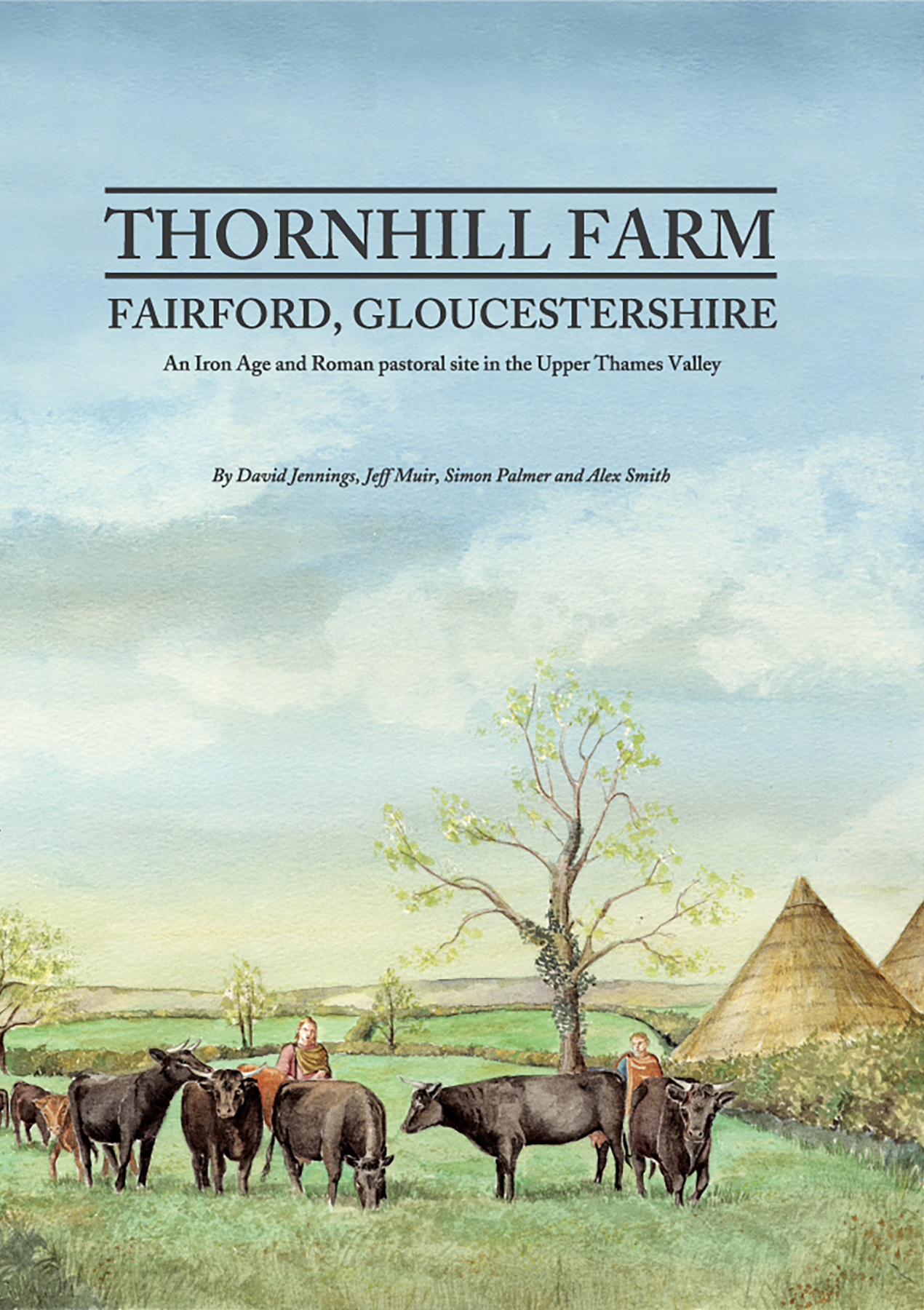
Thames Valley Landscapes Monograph 23
Thornhill Farm, Fairford, Gloucestershire
An Iron Age and Roman Pastoral Site in the Upper Thames Valley
By David Jennings, Jeff Muir, Simon Palmer, Alex Smith

Hardback
£24.95
Add to basket
 Add to wishlist
Excavations at Thornhill Farm revealed a large middle Iron Age–early Roman agricultural complex of paddocks and enclosures for livestock management, with domestic waste and roundhouse traces. The site was extensively reorganised in the early 2nd century AD with new trackways.
READ MORE
Between 1979 and 1989 the Oxford Archaeological Unit (now Oxford Archaeology) undertook extensive excavations of a late prehistoric and Roman cropmark complex at Claydon Pike and Thornhill Farm, Fairford, Gloucestershire. The excavation of the western element of the complex, Thornhill Farm, forms the subject of this report. The excavations were implemented with the co-operation of the Amey Roadstone Corporation (ARC) and formed part of a co-ordinated archaeological response to the threat posed by gravel extraction during the creation of the Cotswold Water Park. The work at Thornhill Farm involved the excavation of numerous evaluation trenches, four open area excavations and extensive salvage operations over a total area of approximately 40.5 ha. The excavations recovered an unusually complete plan of a highly specialised agricultural unit consisting of a dense palimpsest of paddocks and larger enclosures, which appear to have been designed for the effective control and management of livestock. Environmental evidence confirmed that the immediate landscape was characterised by rough pasture which was grazed by large herbivores including horses and cattle. Ceramic evidence suggests that the earliest enclosures were dug during the middle Iron Age, and that the site continued to develop and be remodelled along similar lines through to the early Roman period. Evidence for human occupation was recovered in the form of relatively large amounts of domestic waste consisting mainly of pottery, burnt limestone and animal bone. Although a number of roundhouses were revealed, the precise spatial organisation of the settlement proved difficult to discern, largely because of the relatively high degree of truncation and the ephemeral nature of the structural remains. The site was radically reorganised during the early 2nd century AD when the tightly knit group of paddocks and enclosures which had characterised earlier periods was replaced by a series of newly constructed trackways.