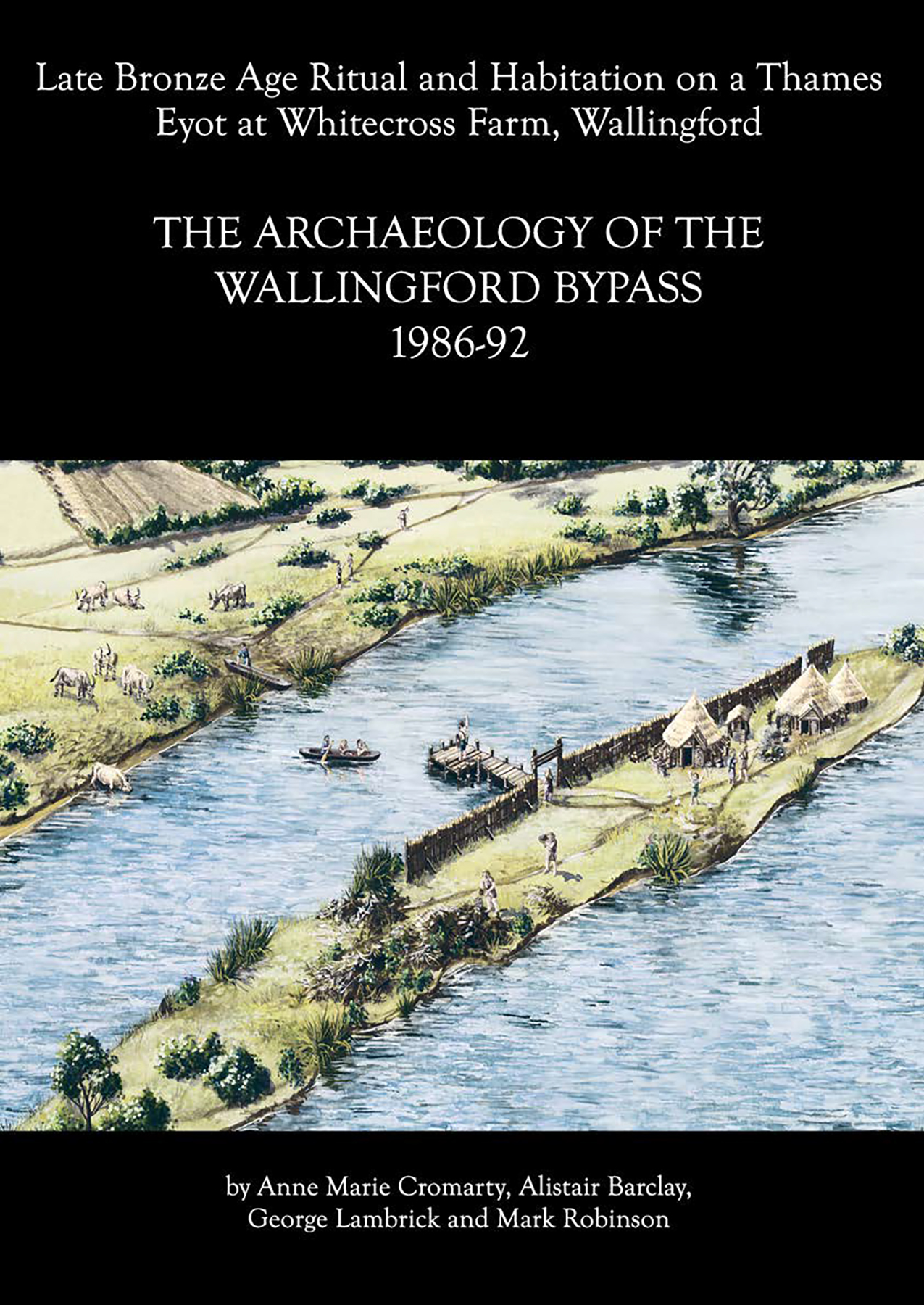
Thames Valley Landscapes Monograph 22
Archaeology of the Wallingford Bypass, 1986-92
Late Bronze Age Ritual and Habitation on a Thames Eyot at Whitecross Farm, Wallingford
By Anne Marie Cromarty, Alistair Barclay, George Lambrick, Mark Robinson

Hardback
£26.95
Add to basket
 Add to wishlist
Excavations for the Wallingford Bypass revealed a high‑status late Bronze Age settlement on a Thames eyot, early cord‑rig cultivation, and dated Grim’s Ditch to the late Iron Age/early Roman period. Additional sites showed multi‑period activity from the Neolithic to Saxon era, enriching the region’s archaeological narrative.
READ MORE
This report presents the results of a series of excavations along the proposed route of the Wallingford Bypass which are of particular interest for three aspects: excavation of a high-status late Bronze Age settlement on an island (eyot) in the Thames; confirmation of the existence of cord-rig cultivation in southern England; and dating of the south Oxfordshire Grim’s Ditch, which places it within a major sequence of earthwork construction in the late Iron Age and early Roman period in the Upper Thames region. The proposal to construct a bypass to the south and west of Wallingford prompted a series of archaeological investigations between 1985–92. Excavations were carried out where the route crossed part of Mongewell Grim’s Ditch, as well as at the known Bronze Age riverside site near Whitecross Farm and a new site at Bradford’s Brook further west that was revealed by fieldwalking. The site at Whitecross Farm was located on a former eyot in the river, with a broad palaeochannel to the west. Initial evaluation of the site enabled the bypass bridge to be designed to minimise its impact on the surviving archaeology. Thus only areas that would be directly affected by the bridge construction were fully excavated. The results of these and earlier limited excavations are presented, together with metalwork recovered from the river nearby. Bringing all this evidence together has allowed the site to be more fully characterised than previously. The site, including timber structures located on the edge of the eyot, and a substantial midden and occupation deposit, has been securely radiocarbondated to the late Bronze Age. The late Bronze Age artefact assemblages are suggestive of a high-status site, with a range of domestic and ritual activities represented. The bank of the Grim’s Ditch earthwork was found to have preserved evidence of earlier settlement, dating to the Neolithic and Bronze Age, and a sequence of cultivation, including ard marks and ‘cord-rig’ cultivation ridges. Pottery and radiocarbon analysis dated the earthwork to the end of the late Iron Age or the early Roman period. A multi-period settlement, consisting of pits, a waterhole, postholes, gullies and field systems, was identified at Bradford’s Brook, Cholsey. The main periods represented are late Bronze Age and Romano-British, while a small quantity of Saxon pottery indicates limited Saxon activity. A large pit containing late Bronze Age pottery, a cattle skull, waterlogged wood and plant remains, a complete loomweight and flint flakes has been interpreted as a waterhole. A series of radiocarbon dates were obtained for deposits within this feature. All three sites are discussed individually as well as within their local, regional and national contexts. Chapter 7 provides an overall discussion of later Bronze Age themes that have arisen through the excavation and analysis of these sites.