Oxford Cotswold Archaeology Monograph 23
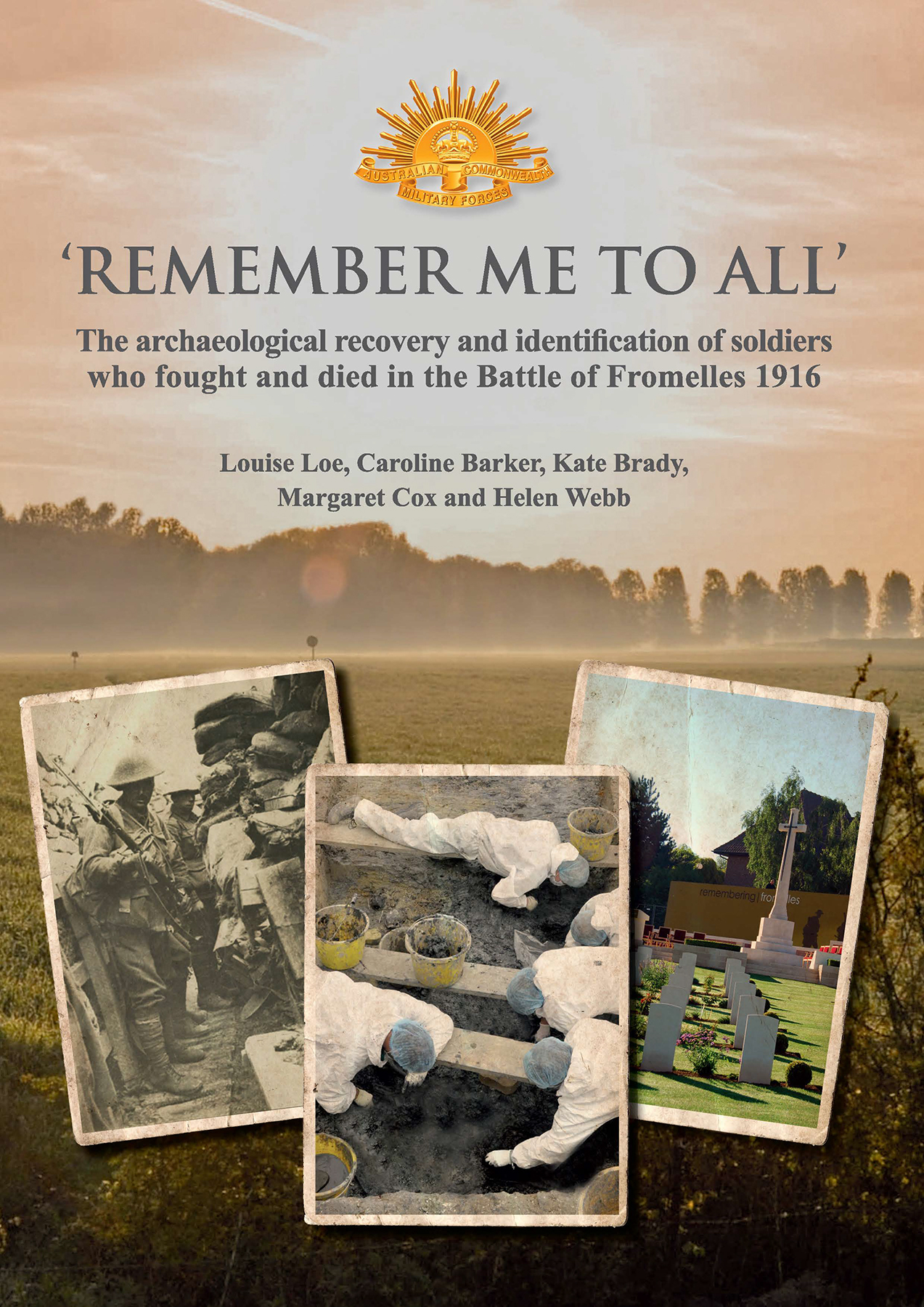
'Remember Me To All': The Archaeological Recovery and Identication of Soldiers Who Fought and Died in the Battle of Fromelles, 1916
By Louise Loe, Caroline Baker, Kate Brady, Margaret Cox, Helen Webb
Hardback
£25.00
Add to basket
Add to wishlist
This volume documents the recovery and analysis of 250 soldiers buried after the 1916 Battle of Fromelles. Using innovative excavation, forensic methods and artefact study, the project achieved the largest modern identification of WWI soldiers, revealing personal details, battle trauma and the stories of those who fell.
READ MORE
Almost 100 years ago, 250 soldiers were buried behind enemy lines in unmarked mass graves on the outskirts of the village of Fromelles, Northern France. They were among several thousand Australian and British soldiers who were killed in the Battle of Fromelles on the 19th and 20th July 1916, many of whom have no marked grave. This volume describes Oxford Archaeology’s contribution to a joint Australian and British government mission to recover the soldiers and re-bury them with full military honours in a new Commonwealth War Graves Cemetery in Fromelles. Bringing together an international team of forensic and investigative professionals, Oxford Archaeology, under the management of the Commonwealth War Graves Commission, excavated and scientifically examined the mortal remains of the soldiers and associated items buried with them. With the full support and cooperation of the soldiers’ families, this evidence was, and continues to be, employed alongside DNA and historical sources in an attempt to identify the soldiers by name for their commemoration on headstones. This volume is a technical synthesis of Oxford Archaeology's work on this landmark project involving the largest recovery and identification operation of First World War soldiers ever carried out using modern science. It also includes detail of the identification process undertaken by appropriately experienced government advisors. The operation commenced in May 2009. Reverend Ray Jones of St George’s Memorial Church in Ypres led a service and Defence Minister Quentin Davies formally initiated the project. With just six months to complete the work, and under intense media scrutiny, innovative techniques were devised to meet the unique requirements of the project. A special site compound was designed to integrate the different elements – excavation, recovery and analysis – of the project, computer software was developed to help interpret commingled remains, and a forensic ‘chain of custody’ approach meant that human remains and associated artefacts had to be signed for whenever they were moved. In these respects the project broke new ground and has arguably become the ‘gold standard’ for projects of this nature in the future. The graves, eight in total, were excavated over a period of four months. The responsibility of recovering, analysing and interpreting them was keenly felt among the team, prompting periods of deep reflection on the battle and warfare in general, and fostering a strong determination to do justice to the evidence and ultimately to the individuals themselves. Precisely how many soldiers would be found was unknown; preliminary investigations suggested 400, while over 1650 soldiers were listed as missing. Soil was meticulously removed, first by a small mechanical digger and then using specialist hand tools, to expose individuals (all practically skeletonised) and artefacts. Teeth and bones were sampled for DNA and all evidence was comprehensively recorded before being lifted and transported to the temporary mortuary. All the graves were highly complex deposits, prone to water infiltration and requiring the exposure of as many individuals as possible before they could be recorded and lifted in a timely and accurate manner, while maintaining the dignity of the deceased at all times. This, in addition to robust water management systems, sampling strategies, and two- and three-dimensional recording by photography, survey and written record, meant that it was possible to recover discrete individuals and make secure associations between the individuals and artefacts. This was of fundamental importance to the identification process and is presented through fully illustrated descriptions in this volume. Five graves were found to contain between 44 and 52 individuals each, buried in two layers with the majority lying across the width of the graves. One grave contained just three individuals lying one on top of the other, and two graves contained no individuals at