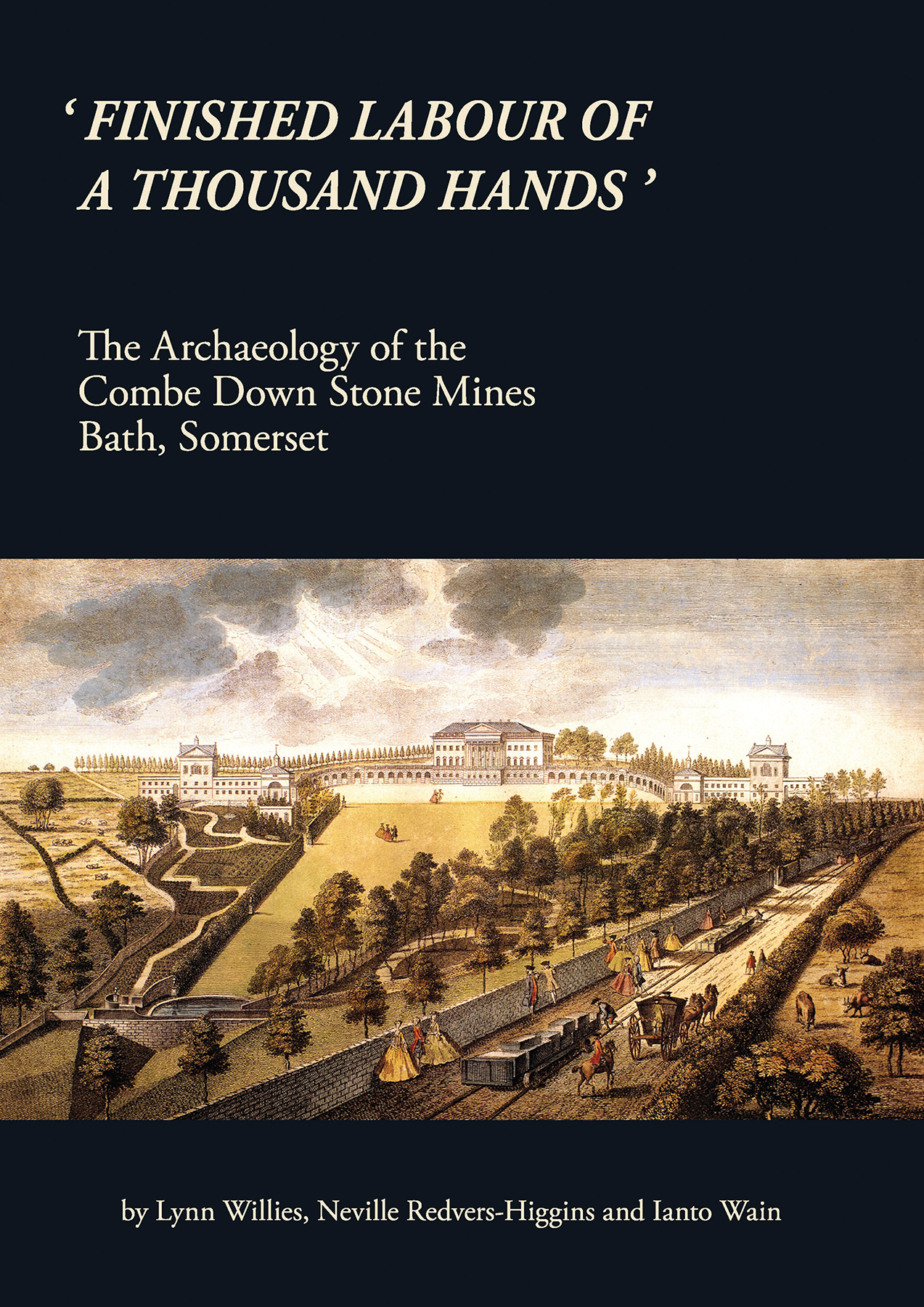
Oxford Archaeology Monograph 13
'Finished Labour of a Thousand Hands': The Archaeology of the Combe Down Stone Mines, Bath, Somerset
By Lynn Willies, Neville Redvers-Higgins, Ianto Wain

Paperback
£25.00
Add to basket
 Add to wishlist
This volume documents Oxford Archaeology’s long‑term recording of the Combe Down stone mines before their stabilisation, revealing 18th–19th‑century underground quarrying linked to Bath’s growth, earlier quarry phases, and the technological development of the workings through detailed survey and archival research.
READ MORE
Between November 2000 and August 2008 Oxford Archaeology carried out a programme of underground monitoring and detailed recording of a section of the underground stone quarries at Combe Down, Bath. The works were carried out prior to and during the stabilisation of the quarries, a process that was carried out by concrete infilling. The quarries (legally mines during the Stabilisation Scheme), were situated below the central Conservation Area of Combe Down, which lies between 1.5 and 2 km south of the historic centre of Bath. A large proportion of the parish was subject to either quarrying underground or at surface over a long period, but mainly between 1730 and 1860, when the area provided the main building material for the ‘golden age’ of Bath. Quarrying in the outer areas of the parish continued, but the main supply of Bath Stone thereafter came from the much larger, rail-served Wiltshire quarries. The recording works were carried out as a long-running Watching Brief, during the construction of a network of supported engineering roadways designed to initially provide safe access to all areas of the mine and latterly to facilitate the filling of the mines with foam concrete. The recording was primarily by drawn and photographic methods, although a range of other techniques such as laser scanning and video photography were employed to augment the traditional techniques. The survey, augmented by programmes of documentary and archival research, has enabled a detailed chronology and technological analysis of the development of the underground workings to be established. These have demonstrated that although stone quarrying was certainly being carried out in the early 18th century and may have been undertaken as far back as the Roman period, the first large-scale exploitation of the quarries occurred during the middle years of the 18th century (c. 1730-1764) under the ownership of the entrepreneur Ralph Allen, who introduced innovative techniques and industrial organisation to the process. Extensive quarrying continued after Allen’s death in 1764 although the central organising influence was ended and the work was conducted by a number of independent quarrymasters or freemasons. Underground quarrying continued in the central Combe Down area until the 1860s and both underground and surface quarrying continued on the fringes of the area until the 1930s. The Combe Down Stone Mines Project is the first time in the UK that the full resources of a professional archaeological body, Oxford Archaeology, have been used to carry out a large-scale archaeological examination of underground quarries. The project successfully demonstrated that such works are compatible with ongoing mining operations where old workings are to be disturbed by development. The strategy integrated thorough archaeological investigation with an extensive examination of documentary and published resources, and the results are presented in this volume.