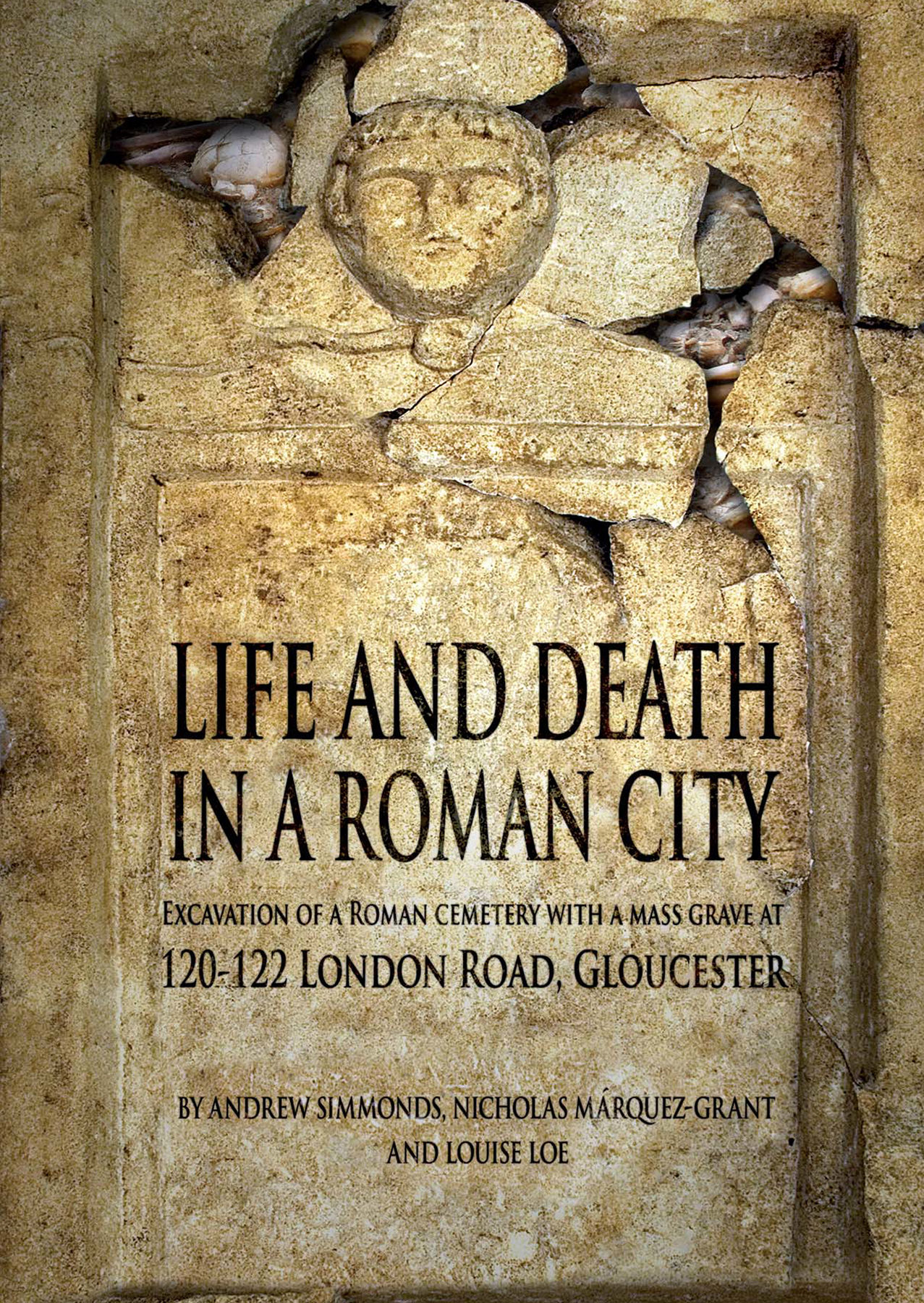
Oxford Archaeology Monograph 6
Life and Death in a Roman City
Excavation of a Roman Cemetery with a Mass Grave at 120-122 London Road, Gloucester
By Andrew Simmonds, Nicholas Marquez-Grant, Louise Loe
Edited by Alex Smith

Paperback
£30.00
Add to basket
 Add to wishlist
Reports excavations at 120-122 London Road, Gloucester, revealing part of the Wotton Roman cemetery, including cremations, inhumations and a rare mass grave. The volume examines burial practice, human remains and evidence for life and death in the Roman city.
READ MORE
Between August 2004 and January 2006 Oxford Archaeology undertook a programme of archaeological excavation and watching brief in advance of construction of sheltered apartments on a site formerly occupied by a disused service station at 120–122 London Road, Gloucester (NGR SO 843 189). These investigations, commissioned by CgMs Consulting on behalf of McCarthy and Stone (Developments) Ltd, recorded burials forming part of the Wotton Roman cemetery, including a rare mass grave, along with an assemblage of Pleistocene vertebrate remains (detailed in Appendix 6). The part of the Roman cemetery within the area of the excavation comprised the remains of at least ten individuals recovered from nine cremation burials and 64 inhumation graves. The cemetery was established during the Neronian period as the burial ground for the fortress at nearby Kingsholm, and subsequently became one of the main cemeteries of the colonia that was established at Gloucester following the departure of the military. Four crouched burials dating from the late 1st–early 2nd century are interpreted as being the remains of members of the native population who had integrated into the community at the colonia. Inhumation superseded cremation as the dominant funerary rite during the 2nd century, after which no further cremation burials were made. The cemetery continued to be used until some time in the 4th century. The evidence for funerary rites is described and the possible beliefs informing them considered. The demographic make-up of the population and evidence for status based on age and sex have also been examined. Strontium and oxygen isotope analysis demonstrated that the population had a range of origins, deriving both from the local area and also from elsewhere in the province of Britannia, as well as a small group probably from the Mediterranean area and two individuals from another, unidentified non-UK source.
The mass grave contained the remains of at least 91 individuals, thrown haphazardly into a pit during the second half of the 2nd century AD. The bodies showed no evidence of violence and are believed to have been the victims of an epidemic. It is tentatively suggested that this may have been the Antonine Plague, an outbreak of smallpox that swept across the Roman Empire between AD 165 and 189.
After the disuse of the cemetery at the end of the Roman period the site appears to have been abandoned, with no further activity being recorded until the area was cultivated during the 11th–15th centuries. Boundary ditches were dug across the site during the 16th–17th centuries, most likely associated with the rebuilding of the adjacent hospital of St Mary Magdalen at this time. These features remained open until they were levelled when the area was developed during the 19th century.