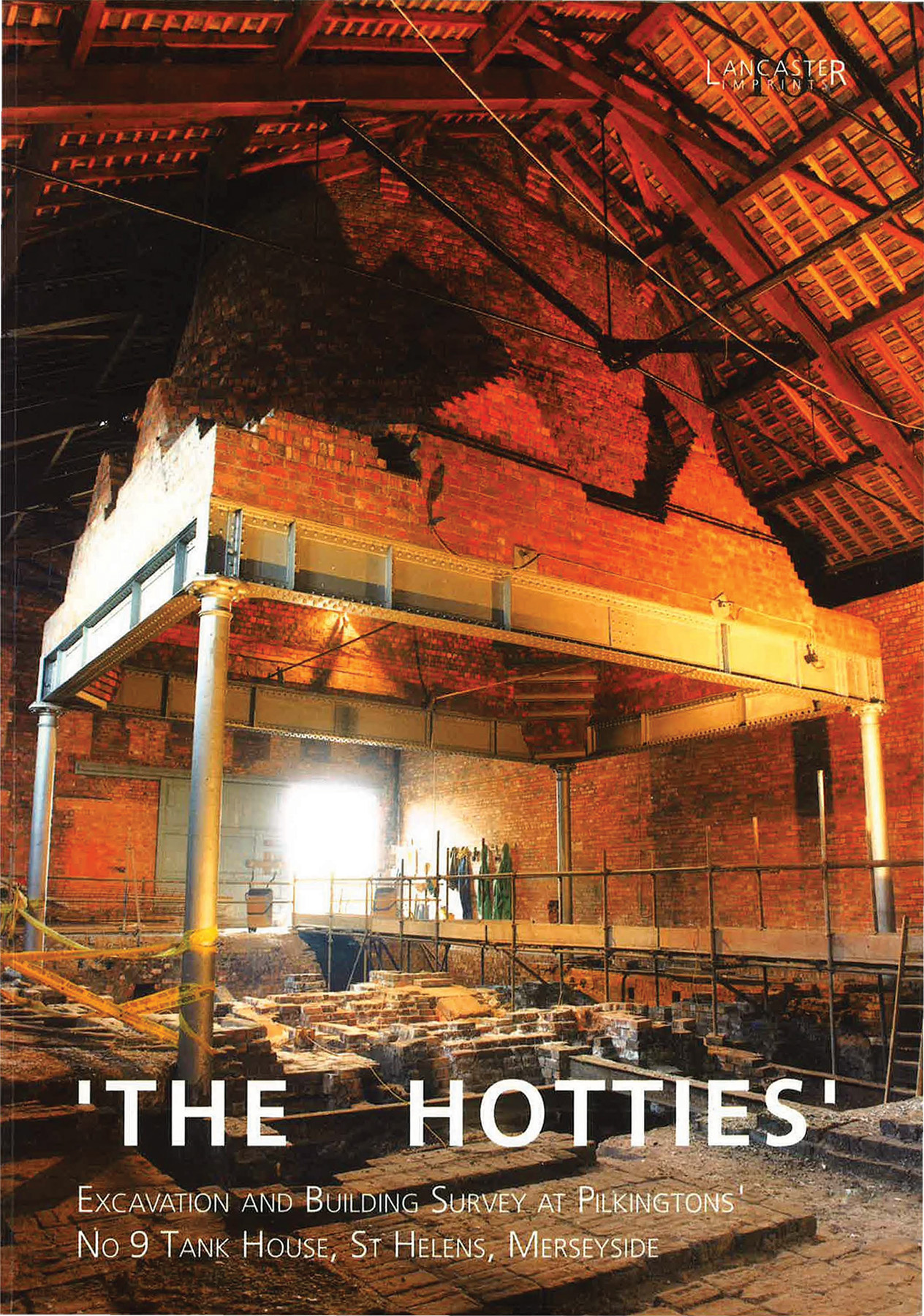
This book presents the 1991–97 survey, excavation, and archival research on Pilkingtons’ No. 9 Tank House in St Helens. A rare surviving continuous tank furnace, now part of the World of Glass museum, it preserves an important industrial monument and showcases the technological heritage of the glass industry.
Between 1991 and 1997, Lancaster University Archaeological Unit (now part of Oxford Archaeology) conducted a phased programme of standing building survey, excavation, and oral and documentary research, targeted on the remains of Pilkingtons' No 9 Tank House, on the 'Hotties' site in St Helens. The cone house element of the complex still stands, and is an impressive Grade II Listed building. The tank house was purpose-built by Pilkingtons in 1887 for the manufacture of window glass using the blown cylinder method, and housed a continuous tank furnace, which made use of the regenerative technology patented by the Siemens brothers. The site, which is bounded to the north by the 1757 Sankey Canal, had previously been used as the pit head of a coal mine and, until 1884-5, was occupied by the Bridgewater Chemical Works; thus, the history of this plot of land neatly illustrates the town's industrial progression from coal, through chemicals, to the glass industry, which still dominates the local economy.
By 1991, the area of the former glassworks had been earmarked for urban regeneration. The cone house and its immediate surroundings were acquired by the newly formed Hotties Science and Arts Centre Ltd, later the World of Glass Project, with the aim of recording and consolidating the remains of the glass surface, and eventually opening the site as a visitor centre. In the same year, Lancaster University Archaeological Unit was commissioned to undertake the first four stages of fieldwork, stage 1 involving a survey of the fabric of the cone house building, the planning of adjacent surface remains, and the archaeological recording of a number of geotechnical test pits. The investigations were commissioned and funded in the first instance by the Ravenhead Renaissance consortium, and latterly by English Heritage. A second phase of investigation, from November 1991 to March 1992, involved the removal of chemically contaminated overburden to a depth of 3.50m from all areas around the tank house, with preliminary excavation of the sub-surface tunnel system located beneath the building. A third phase, conducted in 1993, saw the total excavation of the interior of the tank house, including clearance of the numerous underlying tunnels and flues. Between 1995 and 1997, building work to consolidate and repair the tank house remains proceeded; Lancaster University Archaeological Unit was commissioned to monitor these works, and also to carry out further excavation in two limited areas.
The investigations have revealed the surviving base-level remains of a continuous tank furnace, with its regenerator chambers and gas supply flues still largely intact. Though details of the original Siemens tank furnace design are well known owing to the survival of the original patent drawings, excavation of No 9 Tank House has demonstrated that very significant modifications of the standard design were made by Pilkingtons. Most notable was the division of the furnace into two distinct and independently-heated components, the 'melt end' and the 'working end', housed in two adjacent buildings, each with its own dedicated set of regenerators; this arrangement was developed in order to allow the different conditions needed for melting and refining glass, and gathering and working glass, to be achieved with maximum efficiency, cutting costs and increasing quality. As the commercial sensitivity of furnace design ensured that few detailed records were kept, elucidation of the modifications has been largely dependent on the detailed analysis of the surviving elements of the No 9 Tank House. Pilkington's development of standard furnace design was crucial to its commercial success, and the archaeological investigations have thus given a valuable insight into the reasons for the company's dominance of the British window glass trade from the late nineteenth century to the present day.
The No 9 Tank House remains represent a unique survival


 Add to wishlist